

Stalingrad. The name itself conjures up powerful imagery. The city on the Volga bearing Stalin’s name brings to mind ruined factories, bitter house to house fighting, rubble strewn streets, elusive snipers and desperate men pushed through the meat grinder for a couple yards of concrete.
The 80th anniversary of the historical battle in 1942 for control of that iconic city took place in 2022. Ben and I decided that this would be a perfect time to start a Stalingrad campaign for Bolt Action. We used the Campaign Stalingrad book by Warlord and Osprey Games as the blueprint for the campaign. We played our first game around Thanksgiving of 2022 with Ben taking the Soviets and I the Germans.

As of this article I have eight of the Bolt Action theatre books and I must say Campaign Stalingrad is one of the best of the bunch. It contains numerous scenarios and does a great job of breaking down the history of the battle as well. The scenarios take place not just in the city itself, but the surrounding areas. However, the best thing about the book are the three included campaigns. The campaigns vary in length, but follow the same general structure, abstracting the larger battles with small Bolt Action sized scenarios based on seizing control of territory and gaining victory points.
The campaign we selected to use was the “Attack on the Factory District Campaign” set to start 0n September 28th, 1942. For simplicity’s sake we determined each “turn” or battle would take 5 days to bring us in line with the possibility of Operation Uranus happening roughly when it historically took place if the campaign were to extend out 8 turns or so. However the campaign will have a life of its own and will of course become an alternate history on our gaming table so really historical dates are out the window as we roll forward.
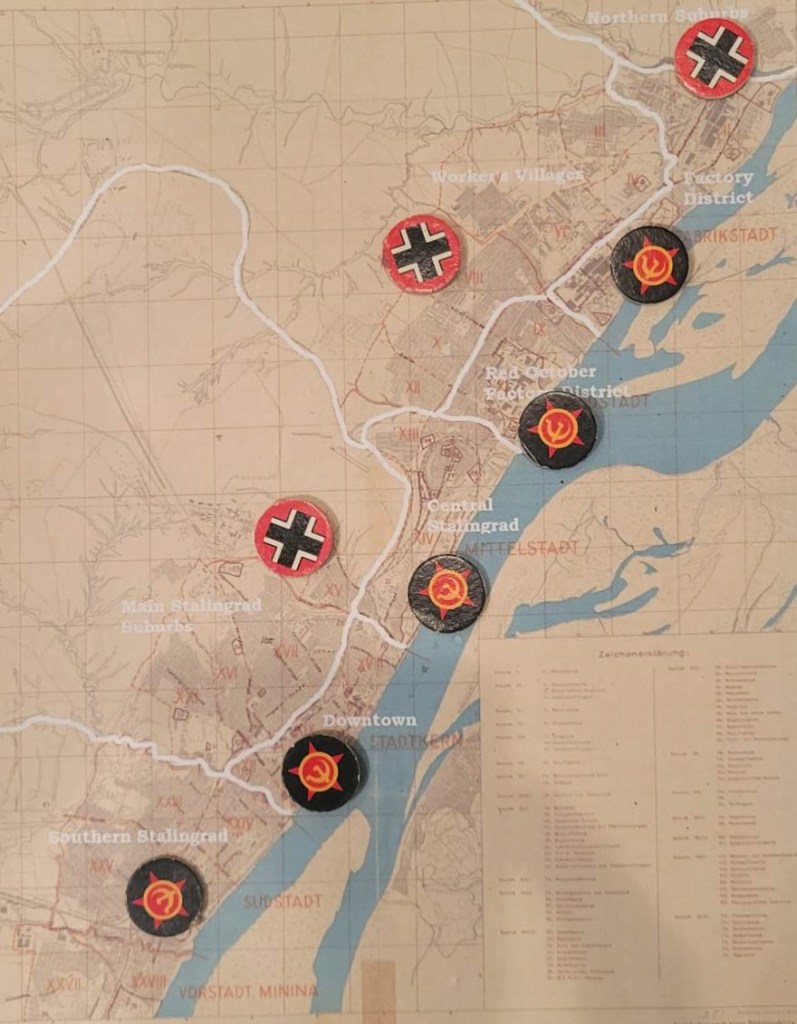
At the start of the campaign we would each control four of the eight sectors of Stalingrad. The Soviets occupied the four sectors in the center along the Volga and the Germans controlled the outlying sectors surrounding the Soviets. The Soviet victory conditions would be to last long enough for Operation Uranus to begin after achieving 40 victory points. The German victory conditions are to control all eight sectors.
As I wasn’t a fan of the generic looking city map in the book, I found an original looking one online. Using my “amazing” computer graphic design skills I doctored up a map of the city dividing it into the same sectors as the one in the book. This would be perfect for us to move the axis and allies control markers I had laying around to signify our flags.

After all, how can you play an area control campaign without the quintessential flag marker map? Now all we needed was a massive table and personnel to push around colored squares with long poles on gigantic maps. But we’ll probably just stick with the 8×11 map and axis and allies counters….
Battles that are fought in the campaign are decided by an order dice draw. Each battle has an “attacker” and a “defender”. At the start of the campaign the Germans have four order dice and the Soviets have two. The dice are placed in an order dice draw bag and two dice are drawn after each scenario to set up for the next. If any combination of German dice are drawn the Germans are the attackers. If two Soviet dice are drawn the Soviets are the attacker. This keeps the Soviets in the defensive role for the majority of the battles and helps it keep its historical flavor. Of course no plan survives contact with the enemy and I screwed up on our initial draw by failing to read the rules completely, only drawing one die which happened to be Soviet. More on that later.
After the draw the winner picks a sector to attack adjacent to one they control. The defender then picks a mission available in that sector to play out. Some sectors have general scenarios and others have very iconic historical battle scenarios. At the end of each scenario victory points earned are added to a cumulative total for each force. As victory points are earned they begin to unlock certain benefits such as being able to add additional dice to the bag to increase the odds of becoming the attacker. The Soviets also could earn the ability to limit the Luftwaffe and the Germans could earn enough extra points to unlock the condition for the Volga to ice over limiting supplies making ties count as victories for the Germans. This equates to all victory points counting toward your total campaign points whether you win or lose and it seems to be a good way to keep a state of “balance” in a campaign even after getting punched in the face repeatedly!

As I said earlier, mistakes were made. The odds were that I would be choosing the place to strike as the German player, but since I screwed up and only drew one die we determined the Soviets would pick where to strike. We decided to let my mistake ride as we just wanted to get playing and Ben chose the Southern Sector to attack.
This sector was the one I was most nervous about fighting in as there was only one scenario in the sector. I decided I would do my best throughout the campaign to recreate the terrain of these battlefields. However, I knew I’d have my hands full with the one scenario in the sector….”The Concrete Monolith” The fight for the Grain Elevator.

One of my favorite things about table top wargaming is creating immersive terrain and interesting scenery for the tabletop. I can play on a basic table, but if I’m the one creating it I tend to put a lot of work into creating a cool visual experience. Sometimes I hit the mark, other times I fail, but I always try to put a lot of effort into making it detailed and immersive. While I realize it’s not a diorama, but a practical game piece, it needs to be visually appealing and functional at the same time. Since starting historical wargaming a challenge for me has been my internal struggle about “getting it right”, but also realizing it won’t be hyper realistic or perfect as that takes money, patience and time I don’t always have. Stalingrad certainly has a lot of iconic terrain and interesting features which, while stress inducing, is also a creative challenge I’ve been looking forward to since getting into historical wargames. In another article I will go through the process of how I constructed my Grain Elevator.
So our first battle was to be “The Concrete Monolith” or the Grain Elevator scenario, but instead of the Soviets defending the elevator, as they did historically in this scenario, the Germans would be defending with 50% of their units in reserve and half of the total points. I also changed the direction of the attack in the scenario so the Soviets would be attacking from the east at the Volga.


After taking about five weeks to construct the Grain Elevator and surrounding battlefield we were ready to play. Ben brought a 1500pt. force of Soviets to fight my 750pts of Germans. It was time to see if the Soviets could reclaim the elevator they had historically been ousted from just days prior to the start of our campaign. The structure was divided into 5 sections for game purposes and we mapped out on a dry erase board how each section was accessible to another. Each section was worth 1 VP. There were also two other objectives each worth two VP’s outside the structure. One would be the power station and the other a vital fortified crossroads position on the west side. Whoever had the most Victory Points at the end would be the winner.
As buildings and rooms in buildings are abstracted in Bolt Action we decided to make the elevator building count as 5 separate structures with the galleries further divided into two “rooms”. The whole structure would also count as a bunker for defense purposes making it extremely difficult to dislodge defending forces with small arms fire. Grain was still burning on the north side of the lower gallery set alight by the retreating Soviets. This created great plumes of smoke obstructing the battlefield that were produced every turn and drifted across the battlefield. There were several ruined structures scattered around the battlefield as well including the connecting power station providing cover and movement challenges with rough ground.
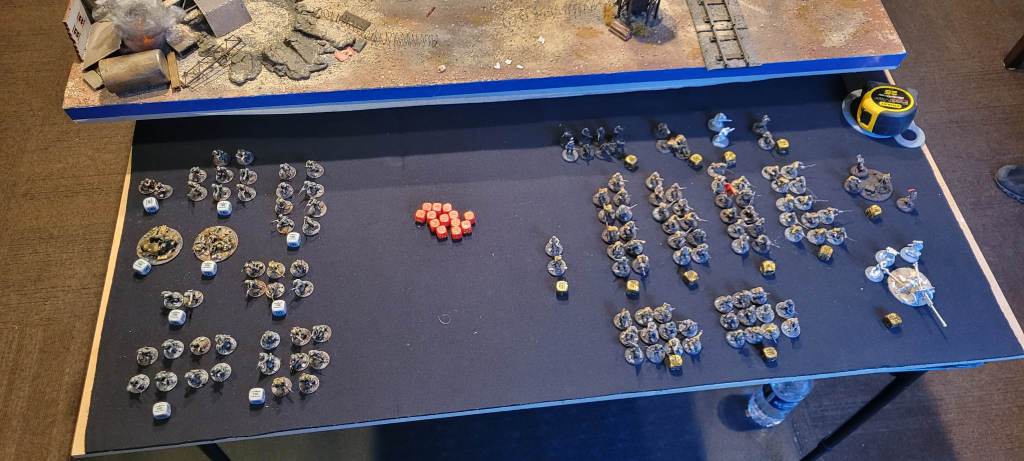

With the stage set I placed my few units onto the board. I put a light artillery piece on the power station upper floor (justifying to Ben they had disassembled the gun and hauled it up with pulleys!), a machine gun team on the top of the headhouse and scattering of regular squads throughout the structure including an artillery observer to guard the floors.

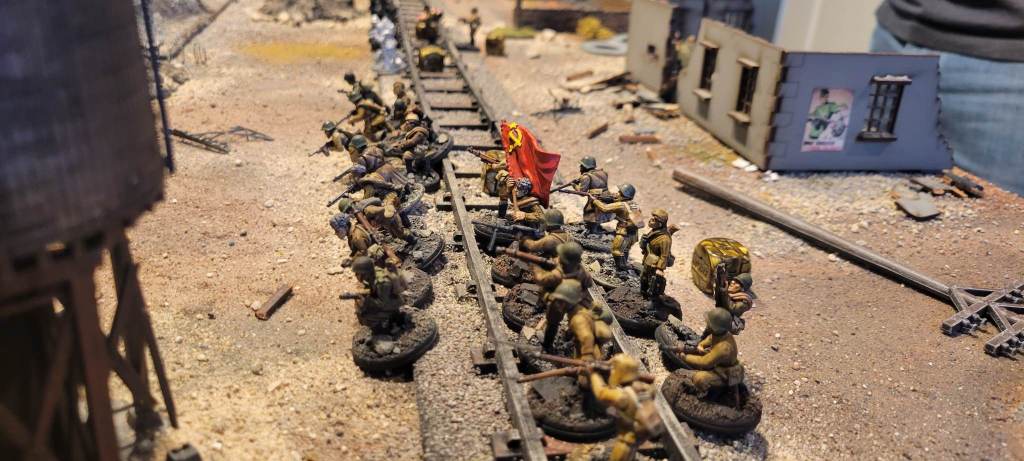
Ben is a solid player and did a great job analyzing my defenses. He came in strong pushing from the east over the railroad tracks and north to assault the lower gallery and headhouse on the southeast. He positioned a Zis field gun on the northeast corner to put pressure on the defenders. His assault engineers and conscripts pushed forward past the tracks and drew a lot of the defending Germans fire. The Soviet conscripts were bathed in fire from defending Germans as they assaulted the lower gallery as a Pioneer squad defended to the last. Yet they pressed on. The artillery observer hit his mark from distant guns on a section of Soviets that moved in from the north. The section’s momentum was stymied with the artillery sending up plumes of dirt and smoke.

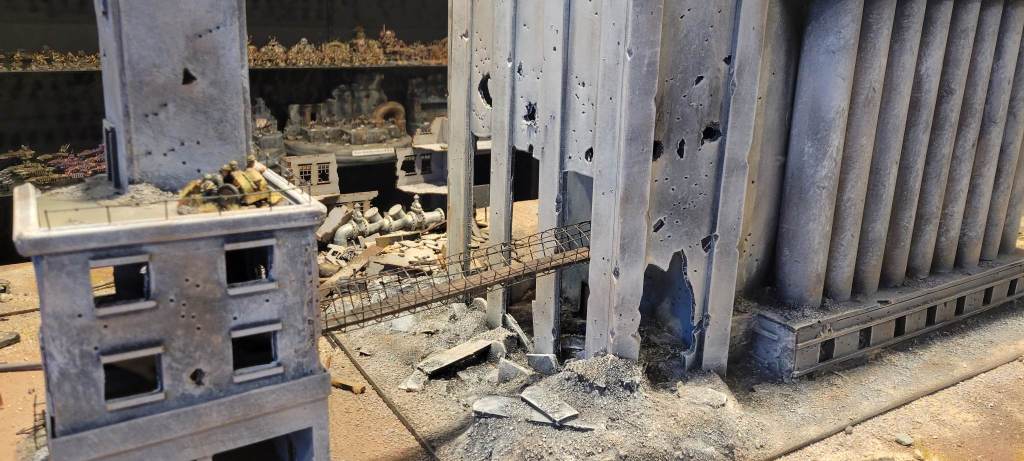

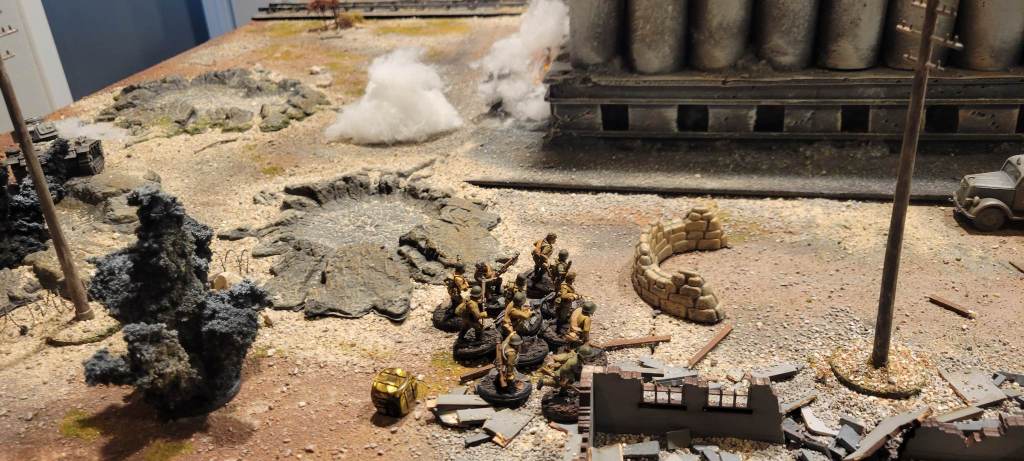


Despite with what appeared to be a tough defense from the Germans, the Soviets swarmed the structure and began a brutal floor by floor assault. The Germans were evicted with extreme prejudice from their newly acquired housing despite attempting to hold off the screaming Soviets. The only saving grace for the Germans was a small Heer team that raced on near the end taking the fortified position at the crossroads securing a couple victory points for the Germans. The Soviets, covered in blood and dust, reached the top of the Grain Elevator and cheered as they had regained control of the structure. They won handily with a score of 7 to 2. They now controlled Southern Stalingrad.


It was a super cool and challenging battle and the terrain made it a great deal of fun for us to play through. Once the battle was over we tallied up the VPs and drew dice for the next game. The Germans secured the attacker status. I decided the elevator needed to be retaken at all costs… and not just because it took me five weeks to build it! It was of strategic importance for the battles to come to secure the southern flank. The General Staff was not happy about losing a week to the sudden Soviet counterattack, but the next battle they would seek to even the odds and continue to grind on through the city toward the factory district. Stay tuned for battle #2 – “The Concrete Monolith” revisited. The battle to retake the grain elevator!

 Iron Dice Gaming
What awesome buildings/terrain.
LikeLiked by 2 people
Very impressive!
LikeLiked by 1 person
That terrain is amazing. Awesome building, so very cool.
LikeLiked by 1 person
Thanks! Drew nailed it yet again. We are planning on bringing it to Adepticon 2024 if you are in the neighborhood.
LikeLiked by 1 person
He certainly did.
Thanks for the heads up, but there is just the little matter of the Atlantic Ocean, so probably not quite in the neighbourhood 😕 though it would be amazing to see it “in the flesh”
LikeLiked by 1 person
Booo. I figured we would be on opposite sides of the ocean. Maybe one day! We all want to take a trip to over your direction. Visit the land of lead and honey. 😄
LikeLiked by 1 person