


A Brief History of the Sonderkraftfahrzeug “Sdkfz” 250/9
During World War II Germany had two main half-tracks chassis families used for combat purposes, the Sdkfz 250 and Sdkfz 251. Both were used extensively by both panzer and panzergrenadiers units. They were built to fulfill missions including transporting troops, mobile fire support, acting as a headquarters unit, reconnaissance, and spotting. The 250 chassis were the smaller of the two and were used for roles requiring a smaller profile vehicle such as reconnaissance.
At the beginning of the invasion of the Soviet Union in June 1941 the mainstay reconnaissance vehicles of the panzer divisions were wheeled armored cars. Wheels offered extremely good mobility on roads and adequate mobility for most off-road conditions. The Leichter Panzerspähwagen (Light armored reconnaissance vehicle) typically the Sdkfz 22x family were used for scouting missions. The heavier 6 and 8 wheel Schwerer Panzerspähwagens (Heavy armored reconnaissance vehicles) saw extensive use as well.

While there was a place for fast wheeled vehicles it turned out that the road network in Russia wasn’t the best. Honestly that’s probably an understatement. Most Russian roads on the German maps turned out to be little more than dirt tracks. Additionally, these roads were used heavily by not only combat units but supply units as well. Some of the roads were down to a single track which made movement of multiple units, along with supply vehicles running both directions, a nightmare.
When the few existing serviceable roads quickly and inevitably began to deteriorate into mud with the changing of the seasons and heavy use the Germans found their wheeled vehicles getting stuck into the thick Russian mud. A stuck reconnaissance vehicle was no good to any commander. Enter the Sdkfz 250 half-track.
The Sdkfz 250 series was designed in the late 1930s and was envisioned for roles that did not need a larger half-track. As with many German projects production delays meant the vehicle was not seen in the field until 1941. The base Sdkfz 250/1 was able to carry a small 4-man squad for recon duty quite handily.
As the Germans had seen that half-track vehicles had superior mobility they began to experiment with mating the 250 series chassis with a quick firing 2cm auto-cannon. The Germans like the additional firepower as their reconnaissance was sometimes done by whacking bushes with copious amounts of lead.

Christened the Sdkfz 250/9, the first experimental up-armed units were deployed in mid-1942 for field trials. After satisfactory performance they entered serial production in early 1943. The 250/9 supplemented and in most cases replaced the wheeled Sdkfz 222 and 232s for scouting duties.
The standard Sdkfz 250/1 had a crew of two and a transport capacity of four. The reconnaissance 250/9 had a larger crew of three consisting of a driver, gunner, and commander. No additional passengers were carried.
Like the armored cars it replaced it was armed with the pedestal mounted 2cm KwK 38 auto-cannon with a coaxial MG34 machine gun. The weapons were mounted in the same armored manually traversed turret of the Sdkfz 222 armored car. Of note are the pair of folding anti-grenade screens covering approximately the front two thirds of the turret. 100 rounds of 2cm and 1100 rounds of 7.62cm ammunition were carried onboard the vehicle.
The turreted scout type was made using both 250 body types, the Alte (Old) and Neu (New). The Alte bodied 250/9s were produced from the 1943 introduction till March or April 1944 when it was supplanted by the Neu chassis. The Neu chassis took less man-hours to produce as it did not have the complicated angular body plates found on the Alte. The larger Sdkfz 251 chassis got the same simplification treatment when it transitioned from the Sdkfz 251C to the late war Sdkfz 251D.

The Required Kits

I decided to build a Neu type 250/9. The vehicle will be used to give my late war Watch Am Rhine German army a quick light punching capability.
I chose Rubicon plastic kits because their vehicles typically go together with minimal fuss. Warlord Games makes a plastic 250/9 Alte (thanks Chris!) If plastic isn’t your jam Warlord Games makes a resin and metal version of the 250/9. In order to make the turreted half-track we need to combine the base Sdkfz 250/1 kit (280038) with the Sdkfz 250/9 & Sdkfz 251/23 (280048) add-on. As of the time of writing, the RRP is $26.00 USD and $15.00 USD respectively. They can be found for under RRP most at most retailers.
The add-on contains enough parts for two upgrades and can be used with the Alte or Neu 250 chassis and the 251D chassis. You can make one of each 250 and 251 based vehicles. The 2cm armed Sdkfz 251D/23 is elusive and from my research appears to have never been produced. In any case you can build one if you want. They are a pretty aggressive looking vehicle.
Unboxing

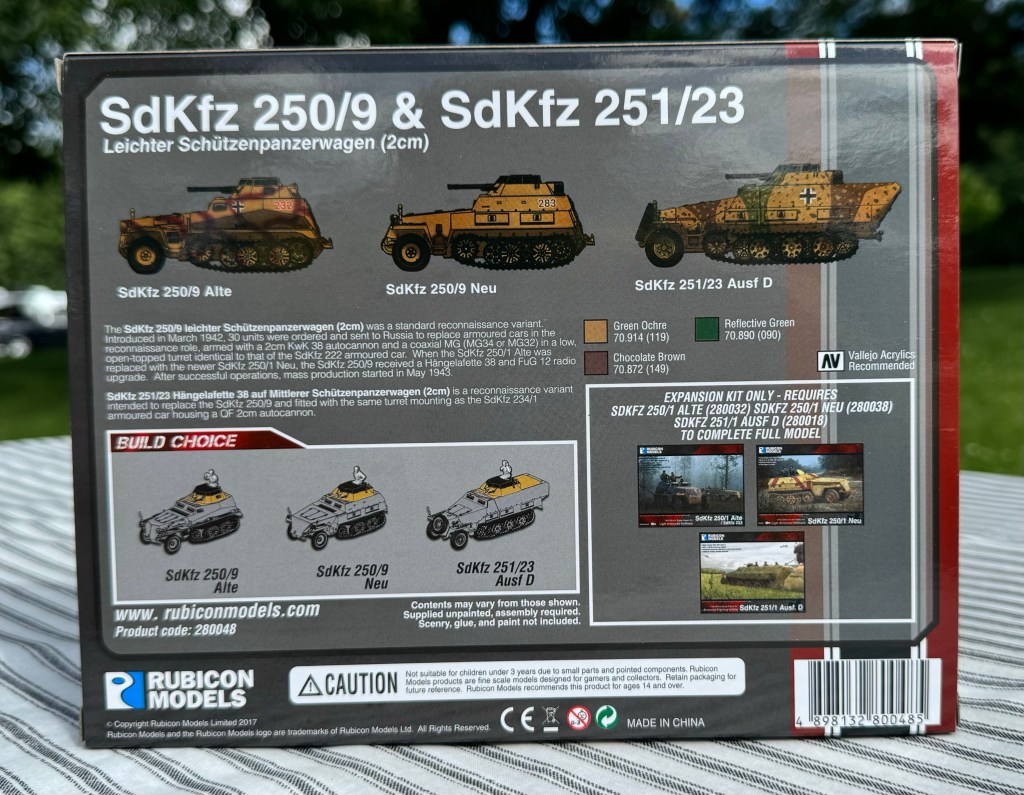
The packaging is the beautiful standard we expect from Rubicon. A bit of history and a look at the decals are on the back of the box. The Vallejo based color palettes are particularly useful.
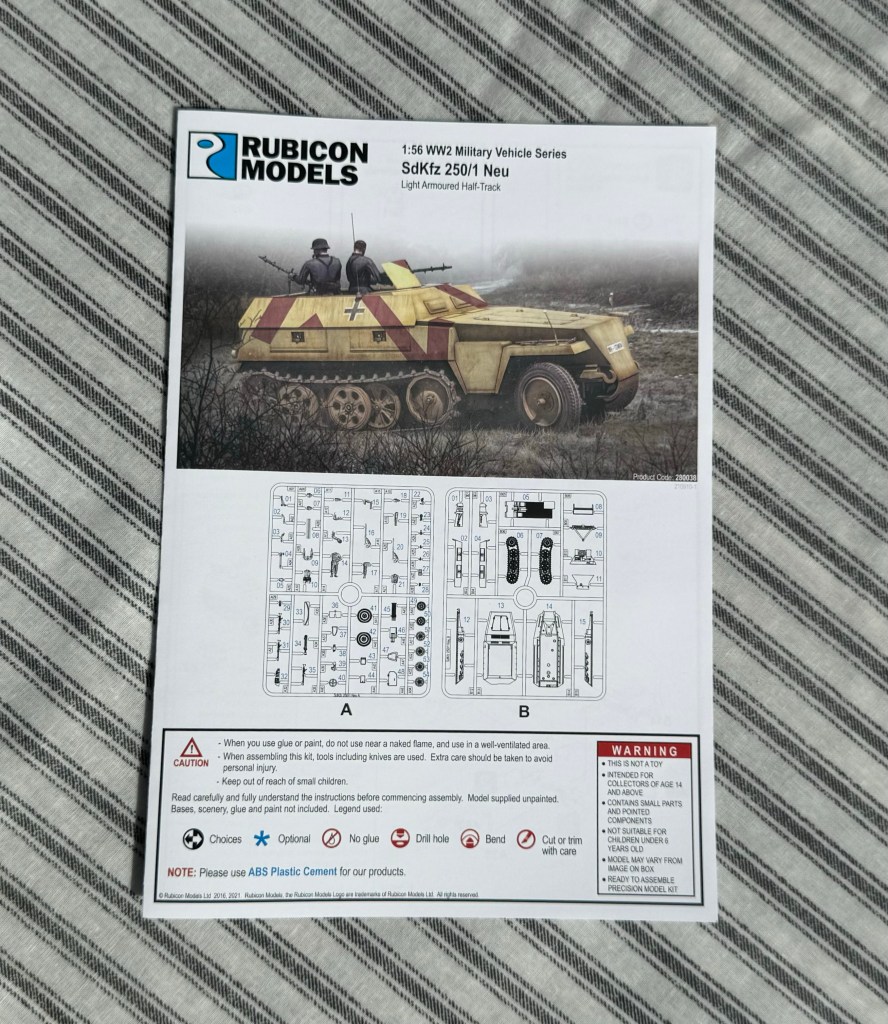


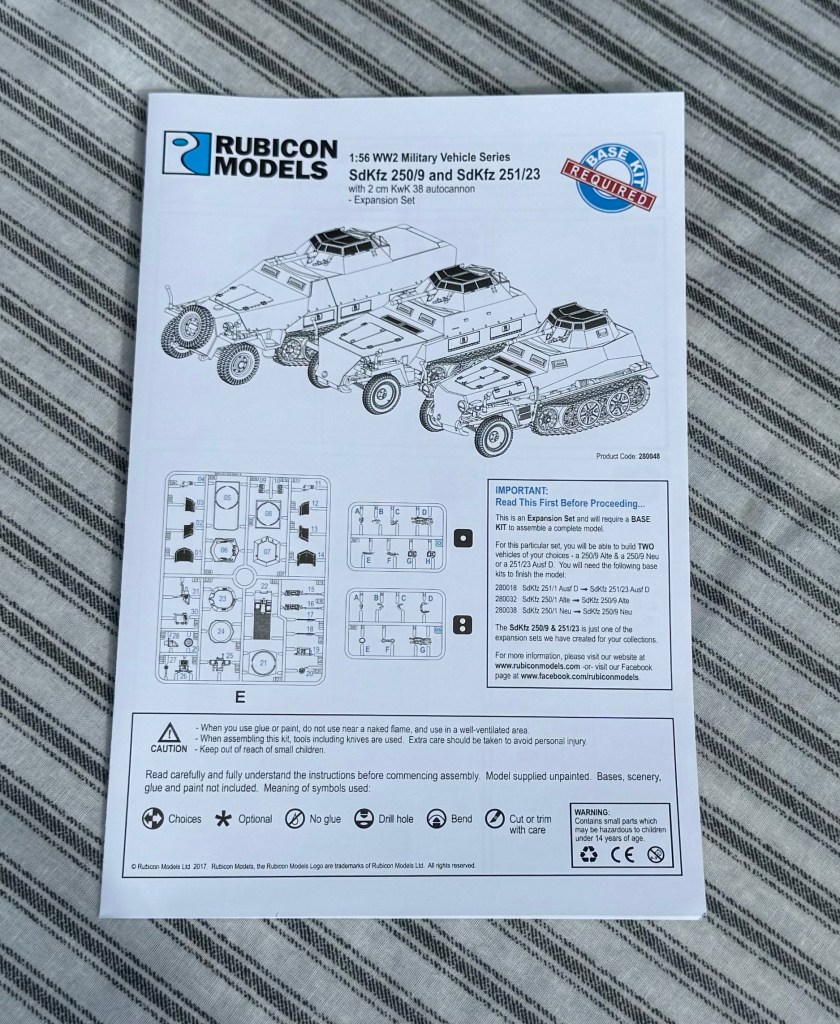
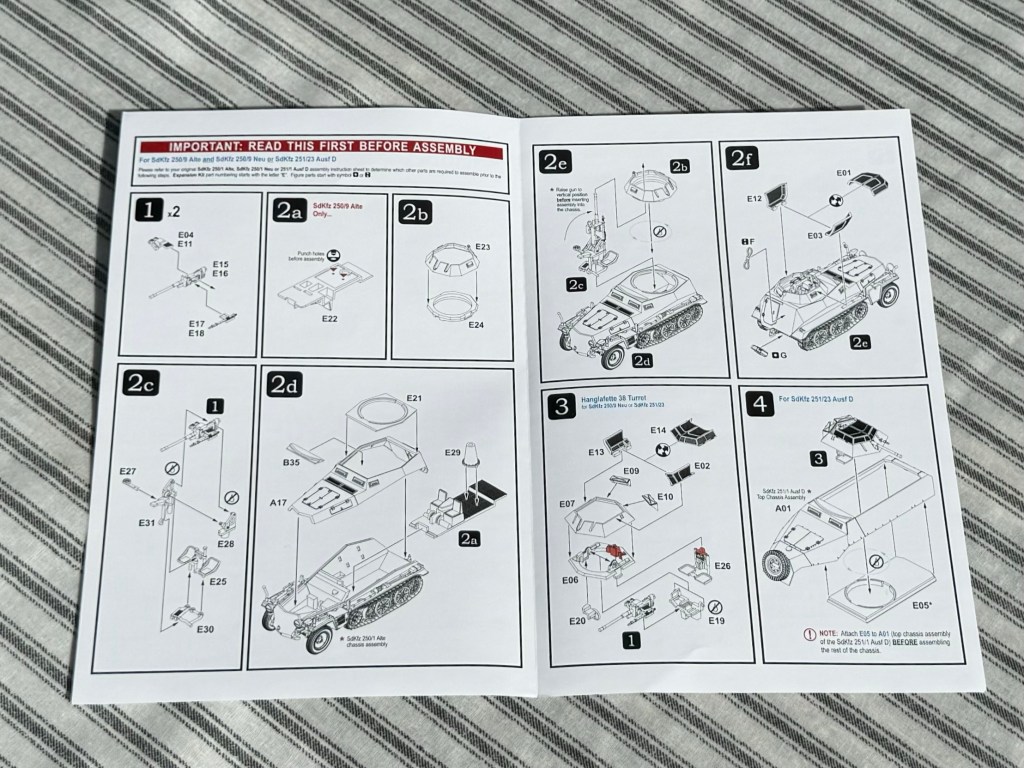
Both sets of instructions were pretty well thought out and easy to follow. The 250/9 requires you to move between the expansion instructions and the base instructions. After a quick review things were pretty clear as to what to do and when to do it.

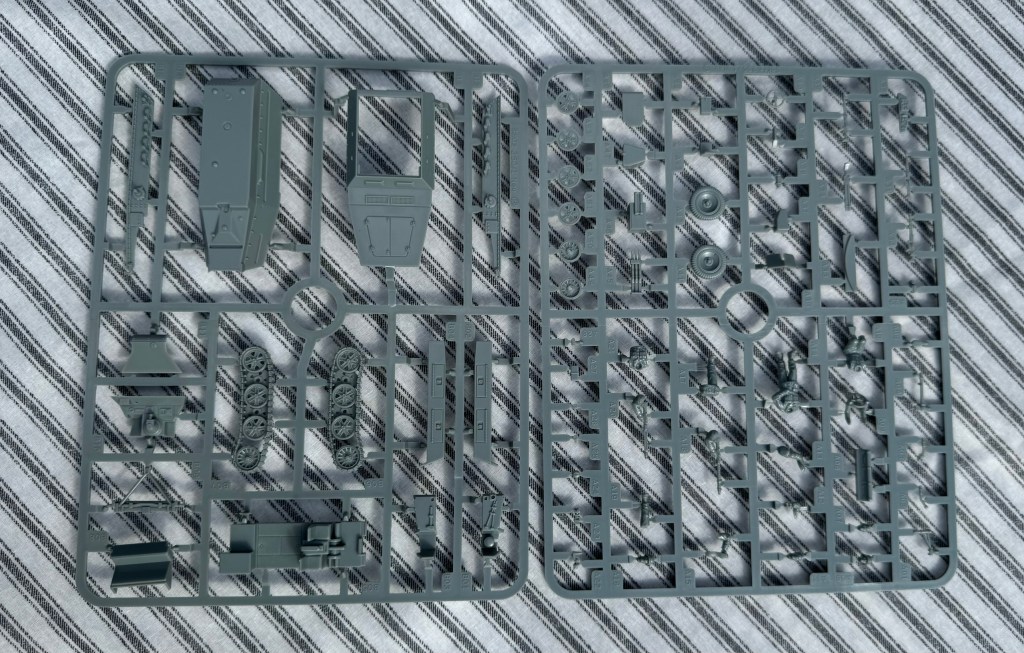

The pair of base kit sprues were well moulded and had minimal flash. What more could you want?
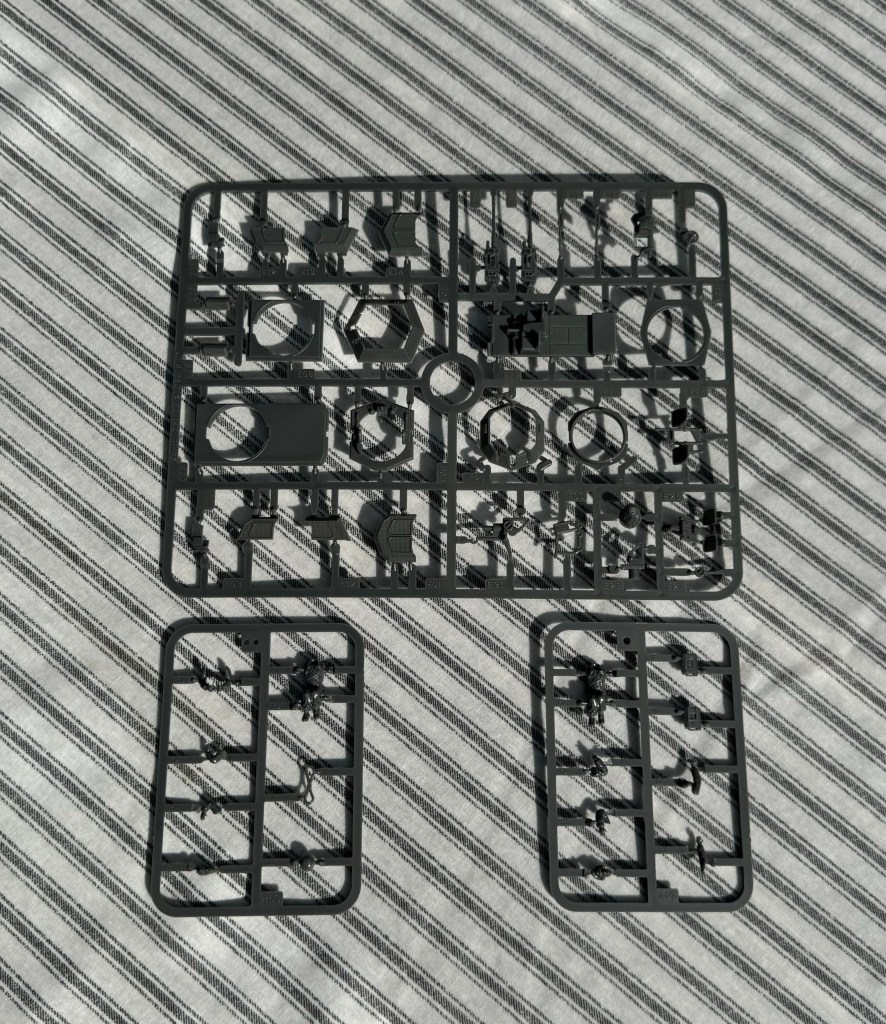

The same can be said about the three turret add-on package sprues. There were no miscasts and as a bonus crew are included.
Construction

The lower hull parts of the kit went together pretty well in the initial steps. The fenders and stowage boxes need to be lined up so be sure to dry fit. The parts needed a little squeeze while the glue set.
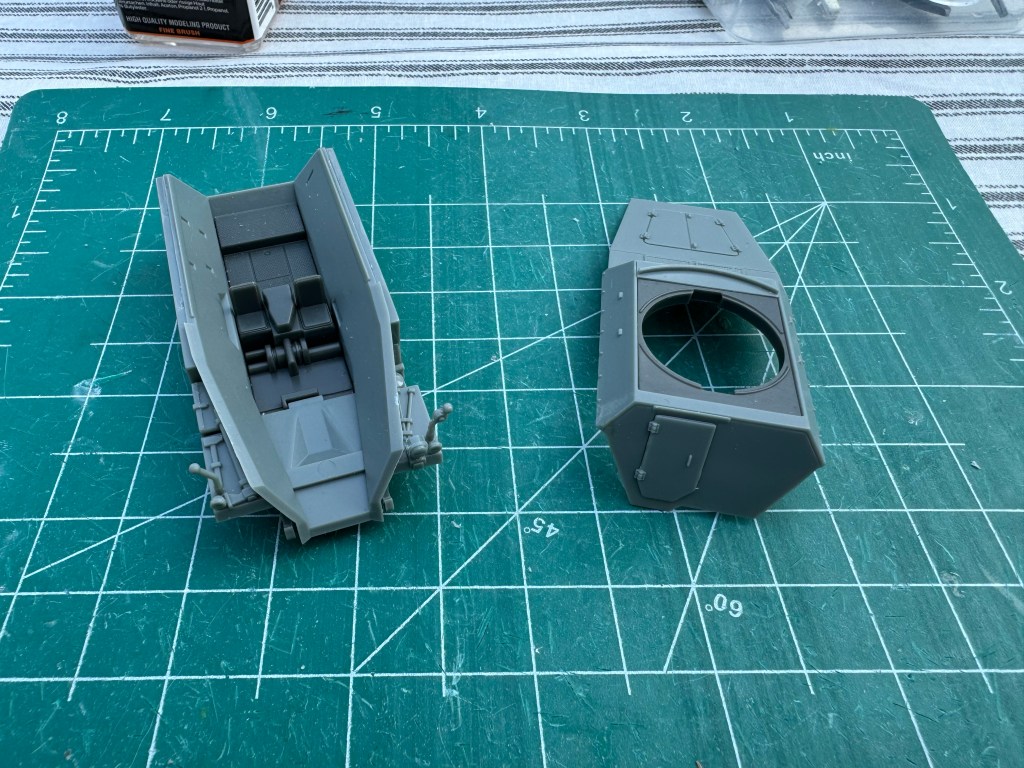
Seeing as I was combining the two kits and the expansion parts are interspersed with the base model kit I decided to only semi follow the instructions. The upper hull was two pieces including the turret ring cowling. Note: the lower hull needed to be built and the upper hull has detail parts added to it prior to closing them together. It is pretty clear what parts go where.
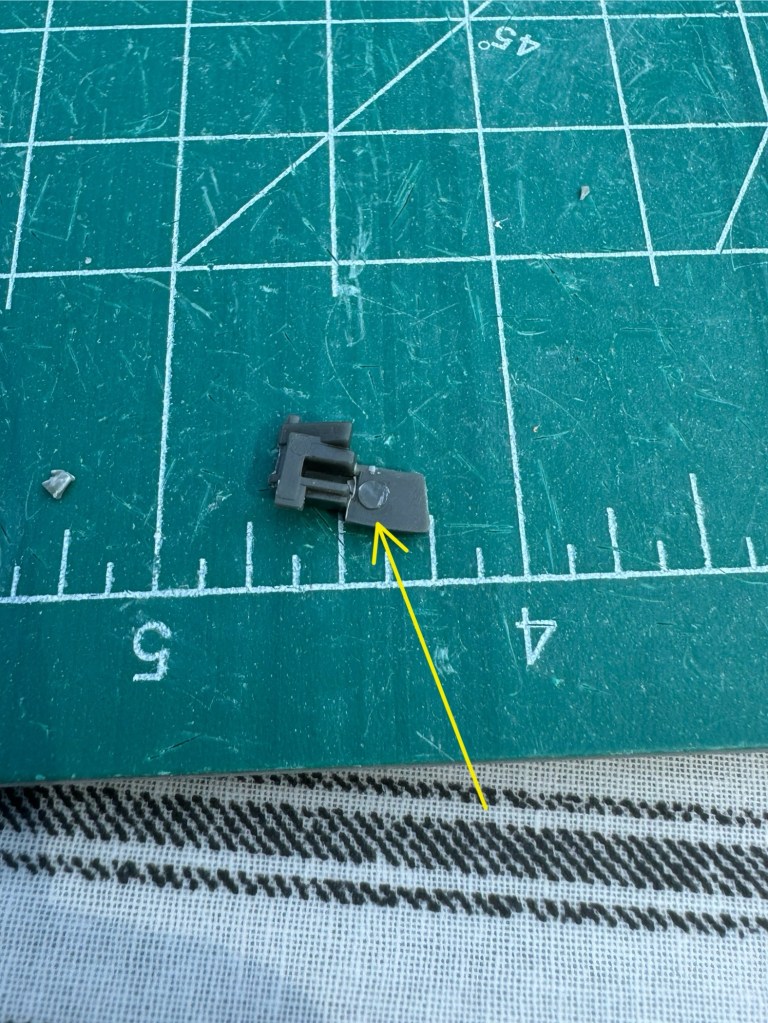
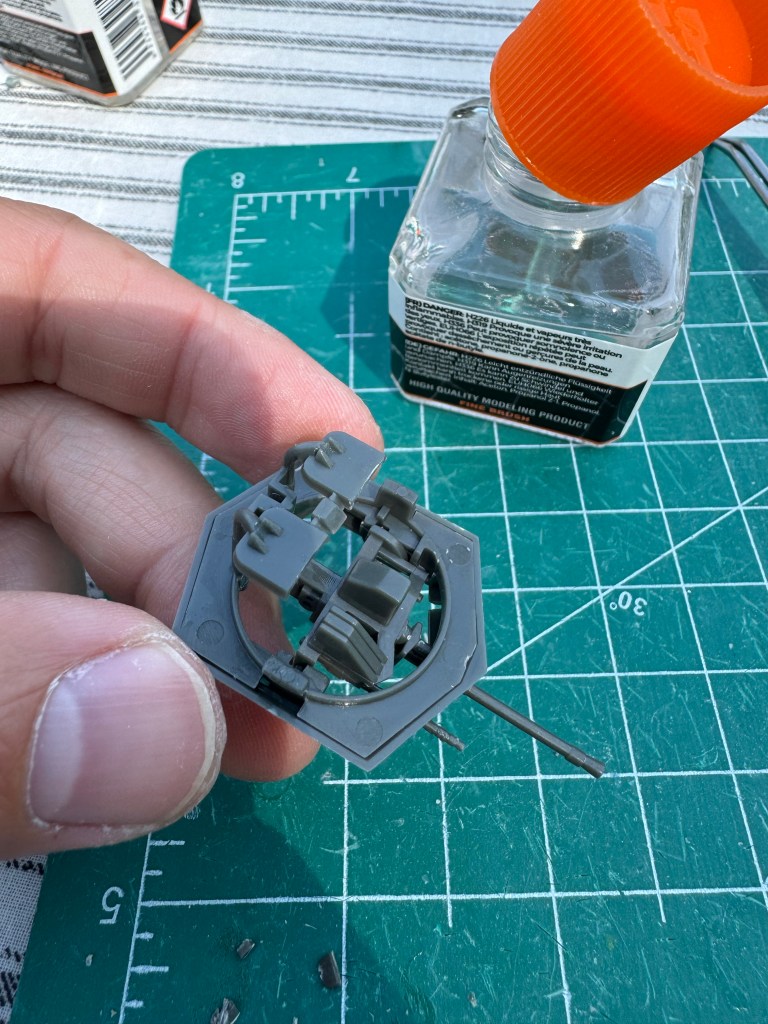
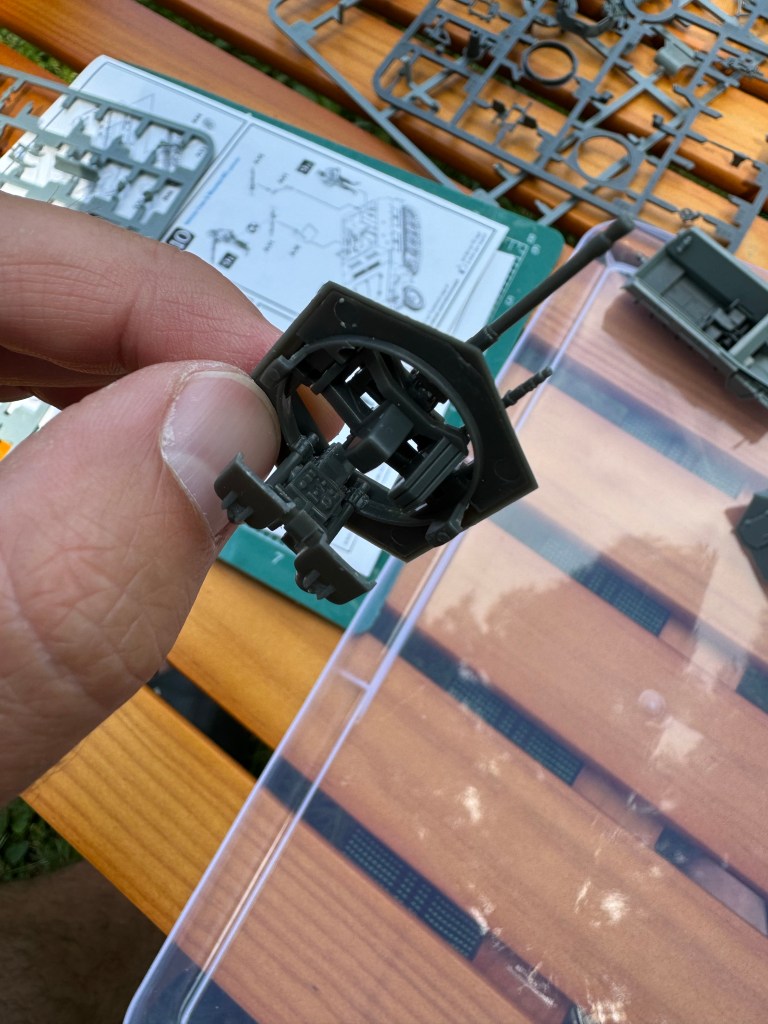


The turret consists of a manner of small pieces. Some parts such as the auto-cannon magazine need to be trimmed in order to fit. Construction of the gun and turret basket were a bit fiddly but nothing that isn’t overcome with a little modeling knowledge. The anti-grenade screens can be modeled open or closed. I also opted to not use the included crew. Rubicon crew tend to be more realistically proportioned. I prefer vehicle crews to match the slightly beefier sculpted infantry I have.
Later in the build process, after I had primed the model, I realized that the turret fit very tightly. It was such an exact fit that it peeled the paint up on the hull roof when I rotated the turret. I ended up cutting off the horizontal retaining lugs to loosen the fit which stopped the paint scraping.

One helpful tip I can impart is that the rear turret stowage boxes have a small lip that hooks onto the top of the turret structure. This provides a nice indexing point for the bins.
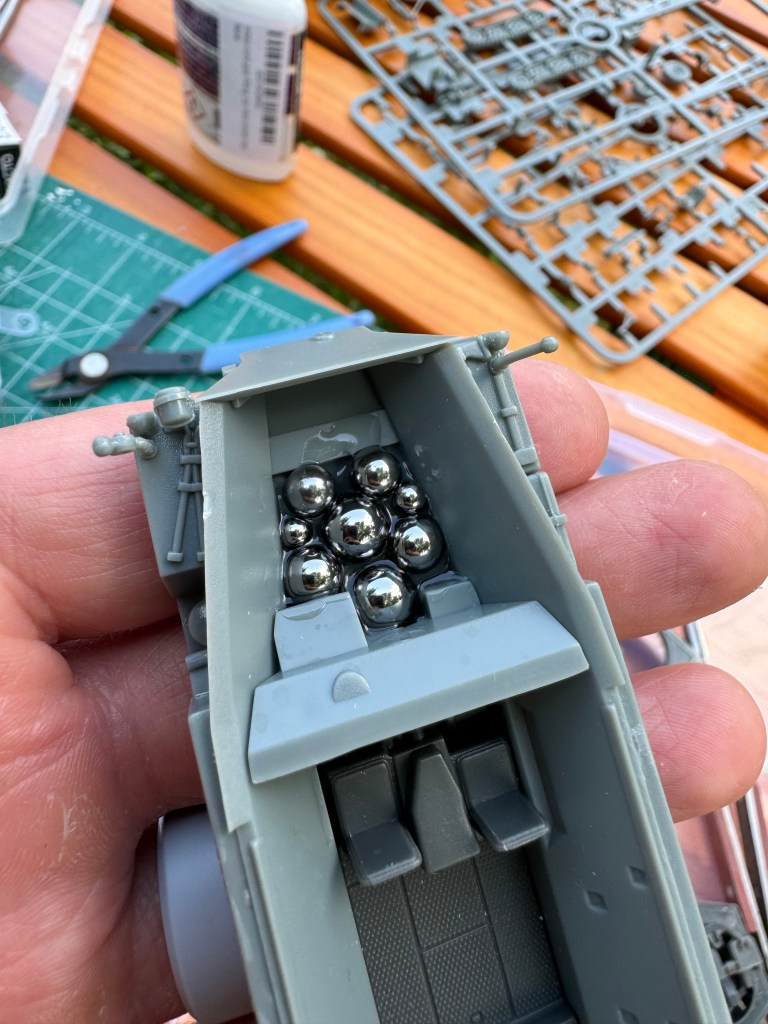
I was still in the 15mm vehicle building mindset, so I decided to super glue some ball bearings in the engine compartment to add some heft to the 250. This isn’t necessary but I like the added weight.
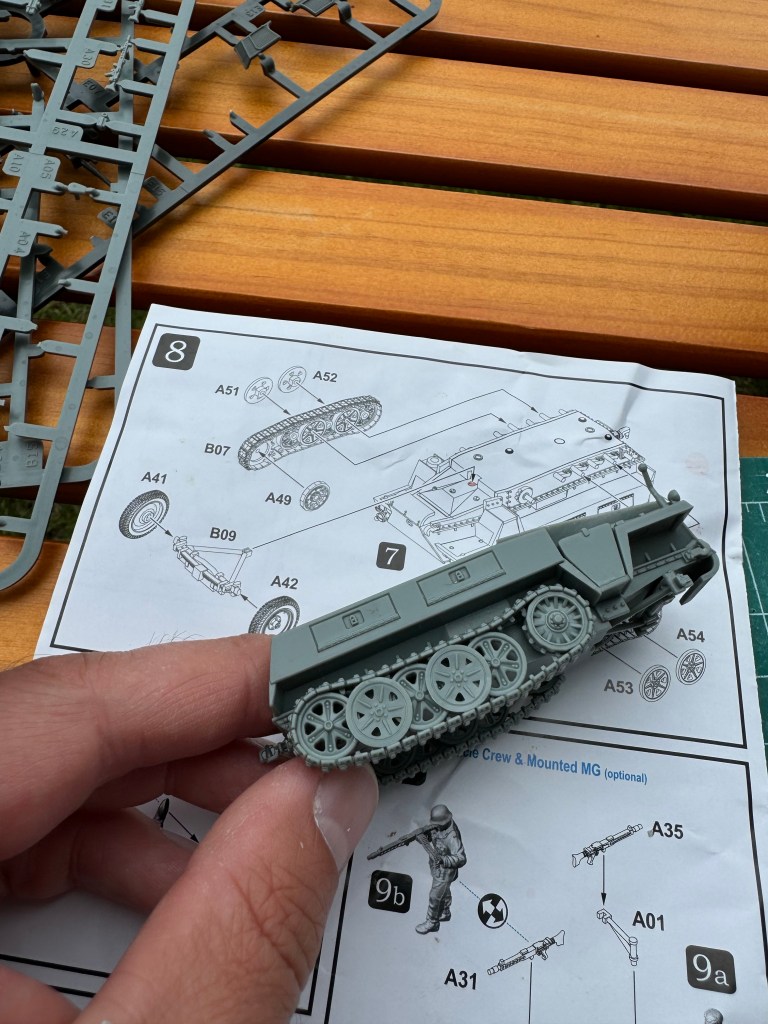
Once the superglue around the ball bearings dried I built and attached the track assemblies. The tracks and road wheel backs are molded as one piece. The drive gears have nice detail. Additional depth is added with the outer road wheels, idler sprocket, and drive sprocket. Once completed the assembly slides onto axles where it is glued for a very satisfying fit.

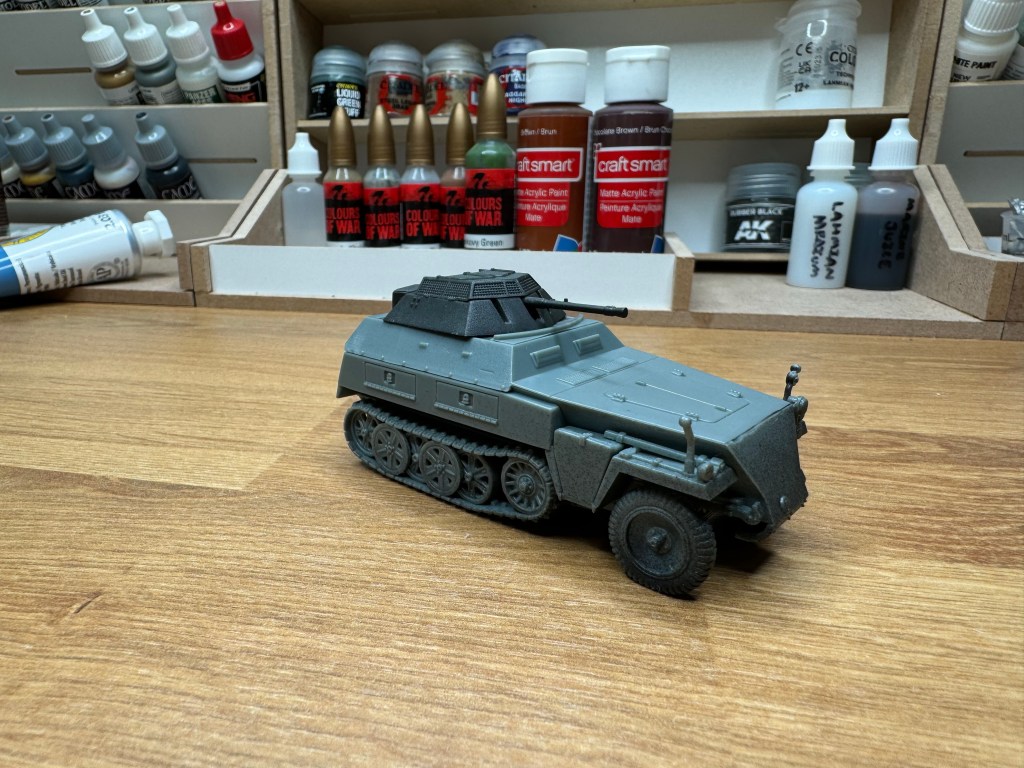
The front steering tires are then added. As seen in the above photo the tire attachment is keyed for proper positioning. As per the Rubicon standard, the tires have a flat spot to simulate the vehicle’s weight on them.

Finally, we mate our top and bottom pieces together. Everything slides together for a snug fit and there aren’t any large visible gaps.

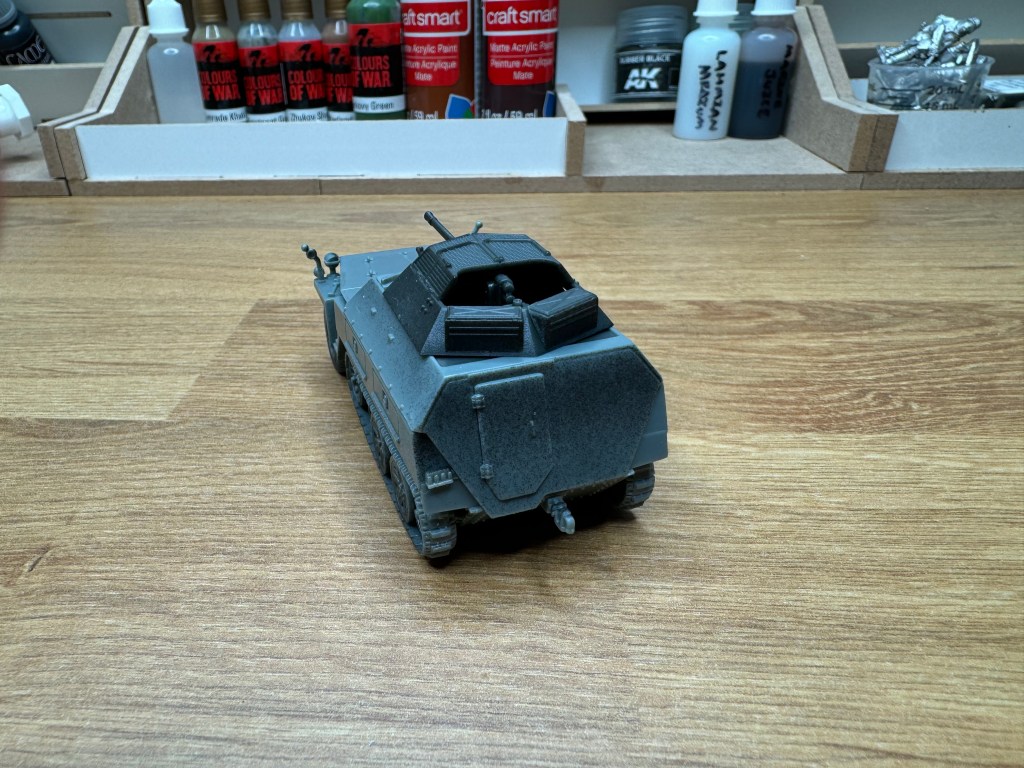
I before I glued top and bottom parts together, I primed the passenger compartment and the inside of the turret. The resulting dusting of black around the turret can be seen in the photo above.

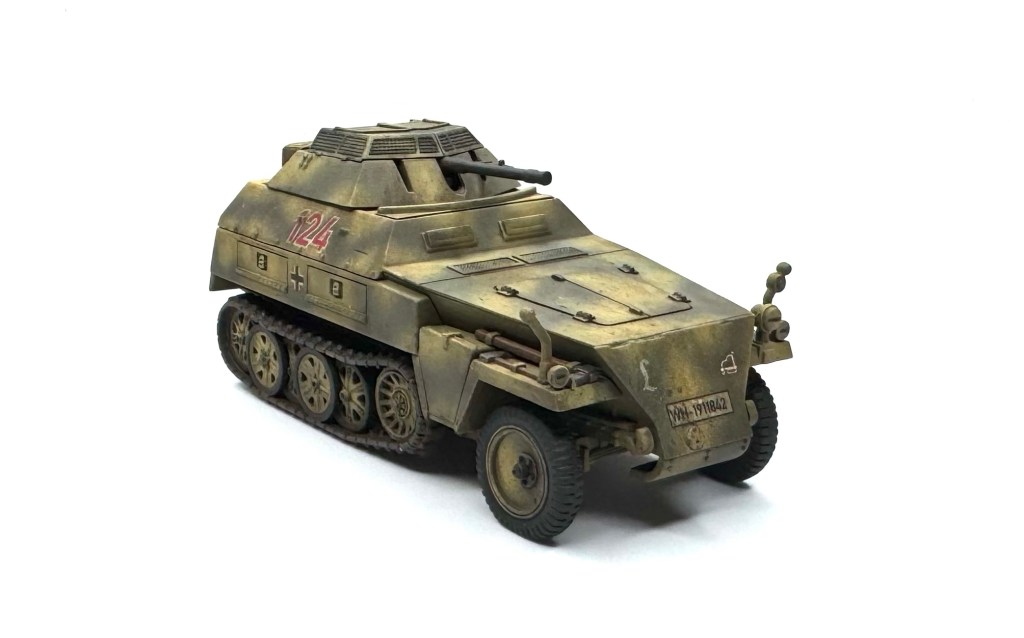
I decided to make my Sdkfz 250/9 a part of Panzeraufklärungs-Lehr-Abteilung 130, the armored reconnaissance element of the Panzer Lehr Division.
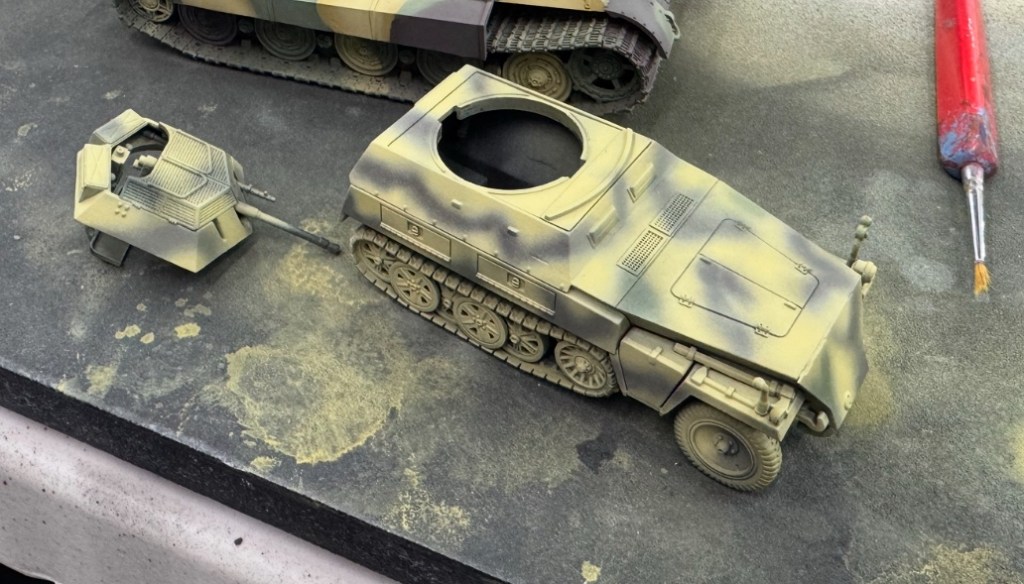
I painted the 250/9 in a batch along with the other German Battle of the Bulge vehicles. A base coat of modulated dunkle gelb was laid down first. I then followed up with a fairly generic and time period plausible soft edged camouflage scheme using Olive Grun and Rot Brun from AK Interactive. Versatility reigns as the paint scheme I chose it could be used in any climate. I didn’t white wash the paint or dust the chassis with snow so its possible to use the half-track in France.
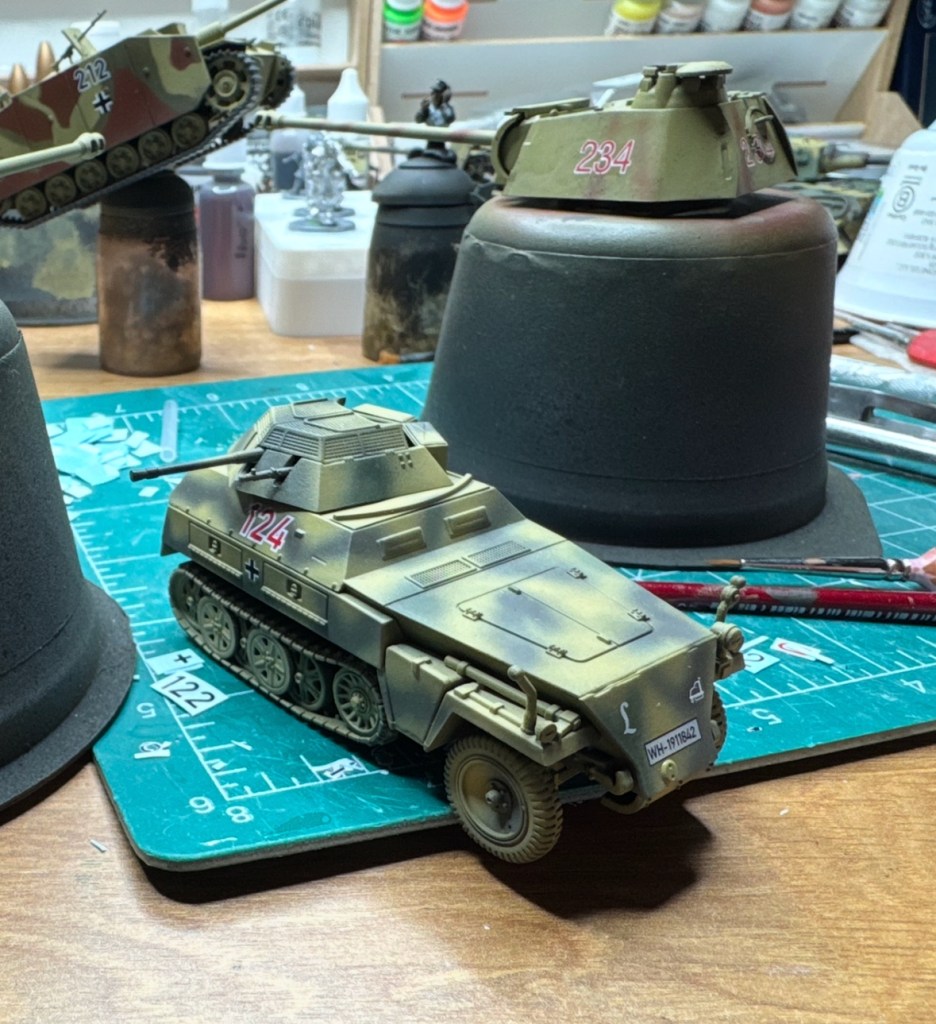
As a humorous aside this was the smallest vehicle of the batch but it had the most decals on it. The decals were a smattering of the provided Rubicon set and ones from District Miniatures. I’m a big fan of District’s decals and I used the Red German Vehicle Numbers, Panzer Lehr, and Halftrack License Plate sets here. I had to splice the German unit type symbol from two separate decals to make a half-tracked armored car company marking. The symbol turned out better than I was anticipating.
The 250/9 in Chain of Command

Sdkfz 250/9
- Armor: 2
- AP: 3
- HE: 6
- Secondary Armament: Co-ax MG
- Speed: Fast
- Notes: Open Turret, Low Profile, Small, 20mm Autocannon
As a fast scouting asset the Sdfkz 250/9 comes well equipped. When consulting the consolidated arsenal we see the auto-cannon half-track is available for forces from May 1943 to the end of the war. The CoC2 rulebook has an updated listing as a support list 4 item. This vehicle including a junior leader will cost four support points to bring with your force. Boasting a respectable 2cm auto-cannon with 6 HE dice and 3 AP dice it will be able to harass infantry, gun teams, and light vehicles. It has a coaxial machine gun for anti-infantry work or suppressing fire.
Just like the real world counterpart, a protracted firefight (dice fight?) with the 250/9 isn’t advised. An armor value of 2 means it will shrug off small arms fire but anything more will give you a bad day.
The 250/9 has a fast speed meaning it adds 2” per D6 of movement.
This halftrack is Open Topped which makes it more vulnerable to artillery and infantry hand grenades.
The 250/9 has both the Low Profile and Small key words giving it a rare automatic -2 adjustment to the “to hit” score needed. Seeing as it’s relatively short and compact for reconnaissance duty this synergizes with the role.

In Bolt Action
With the new Version 3 Armies of Germany book out we find inexperienced, regular, and veteran variants of the 250/9 costing 72, 90, and 108 points respectively. For the cost you get 7+ Damage value, reflecting its thin skin. It totes a light auto-cannon (2 shots +2 pen, HE 1” 48” range) and coaxial machine gun.
The 250/9 counts, very unsurprisingly, as a half tracked vehicle for mobility.
The 250/9 also counts as an Open Top vehicle which means it receives pins like infantry do. Also, if it’s assaulted the open topped half-track is destroyed automatically if it is damaged. Finally, units shooting indirectly at the 250/9 get a net +2 to the penetration on the top armor and an additional +1 to the damage result roll. The moral of the story is “don’t get hit.”
Luckily, the 250/9 has the Recce special rule which allows it to react to a shot from an opponent with a move to (hopefully) get out of line of sight. This can only be done if the half-track has not been issued an order on the current turn and the recce move will count as its order.
Finally the 250/9 has the Flak special rule which allows it to automatically shoot at enemy aircraft if they are brought in.
Conclusion
While the Rubicon Sdkfz 250/9 takes two kits to make it is a valuable and interesting toy for a mid to late war German force. Mine saw action at this year’s Adepticon in a Panzer Lehr supported assault by the 26th Volksgrenadier Division. Typical for Rubicon this pair of kits did not disappoint with their straightforward construction and fidelity to the real vehicle. While there are a few smaller parts and fiddly bits I think it gives a faithful representation of the actual vehicle while maintaining the hardiness required for a wargaming kit.
 Iron Dice Gaming
Excellent write-up and review. Warlord’s plastic 250/9 Alte kit is actually one of their better kits if you ever decide to build another. Although I would recommend leaving out the pedestal and most of the parts of the autocannon assembly. Lots of tiny parts and very frustrating to assemble. Eventually I gave up and glued the autocannon/MMG assembly directly to the turret instead. It looks like Rubicon went a slightly different route with their kit. Building a 251/23 is tempting, so I might have to consider building one of the Rubicon 250/9s as well.
LikeLiked by 3 people
Thanks Chris!
I will amend the article to add the plastic Warlord 250/9 Alte option. I didn’t see it on KAMO’s website when I did my intelligence drag. I’ll have to pick one up soon. A positive review from a friend goes along way!
Thanks for the heads up about the pedestal. The Rubicon one wasn’t much fun either. I’ll probably end up mounting the gun like you did.
Rubicon was onto something by including 2 upgrade kits in one box 😆 If you are doing a 251/23 maybe I’ll have to follow suit… That or you can have my extra bits for the 251/23. Unless you want an excuse for more half-tracks of course…
LikeLiked by 1 person
Excellent review and guide to making an iconic half track.
LikeLiked by 2 people
Thank you for the kind words. A post 11 months in the making 😆
LikeLiked by 2 people
A very nice model and a good post all round, Ben! 🙂 At some point I have a 250/9 to paint, having re-shuffled my German recce unit!
LikeLiked by 1 person
Thanks John! It was a fun exercise to put all the pieces of the article together. I have another two in the pot at the moment and I’m glad the effort wasn’t wasted. 🤪
What do you have in your recce unit? I am looking to do one as well.
I wish I could partake in your June painting challenge but I’m away on holiday for a bit and not able to hit the painting table. I’ll be watching you all with excitement.
LikeLiked by 1 person
I think being on holiday’s a good reason for not being able to paint! 🙂 I’m being very slow with my Jagdpanther for the challenge but I am making progress and would also like to finish an M3 75mm half-track as well if I can!
I’ll try and condense my recce unit down to the essentials! I use a 1:20 model-to-vehicle ratio for my WW2 units so my late-war German armoured recce battalion has five vehicles, one for the HQ company and one for each of the recce companies. Although 20mm- and 75mm-armed vehicles would be spread across the battalion, I tend to represent them with single models allocated to the most relevant company (hope that makes sense). So, I have:
HQ Co. – one SdKfz 234/1 (or can be an SdKfz 231 for earlier 1944)
1st Co. – one SdKfz 250/9 (but I have the option to replace with a Puma or Lynx)
2nd Co. – one SdKfz 250/1 + four infantry
3rd Co. – one SdKfz 251/1 + eight infantry (or can be four infantry with an SdKfz 250/1 or Schwimmwagen for earlier 1944)
Heavy Co. – one SdKfz 250/8 (this would be better represented by an SdKfz 251/9, but the 250 looks “more recce”)
I hope this makes sense! I’m glad you asked about this as I’d planned to revise my organisation to the above and I’ve now made some notes for myself. The above organisation is for post-April 1944 but I have extra optional vehicles to let me represent a unit from mid-1943 onwards, which gets a bit more complicated! I get the impression that the lighter companies could use Schwimmwagens or Kettenkrads if armoured vehicles weren’t available
LikeLike
Great model.
Looks fantastic painted 👍
LikeLike