

Welcome to the first of a new series of articles “History to Hobby” where we’ll explore something from history be it equipment, an event, or something else and then take a look at how it plays in our favorite wargames.
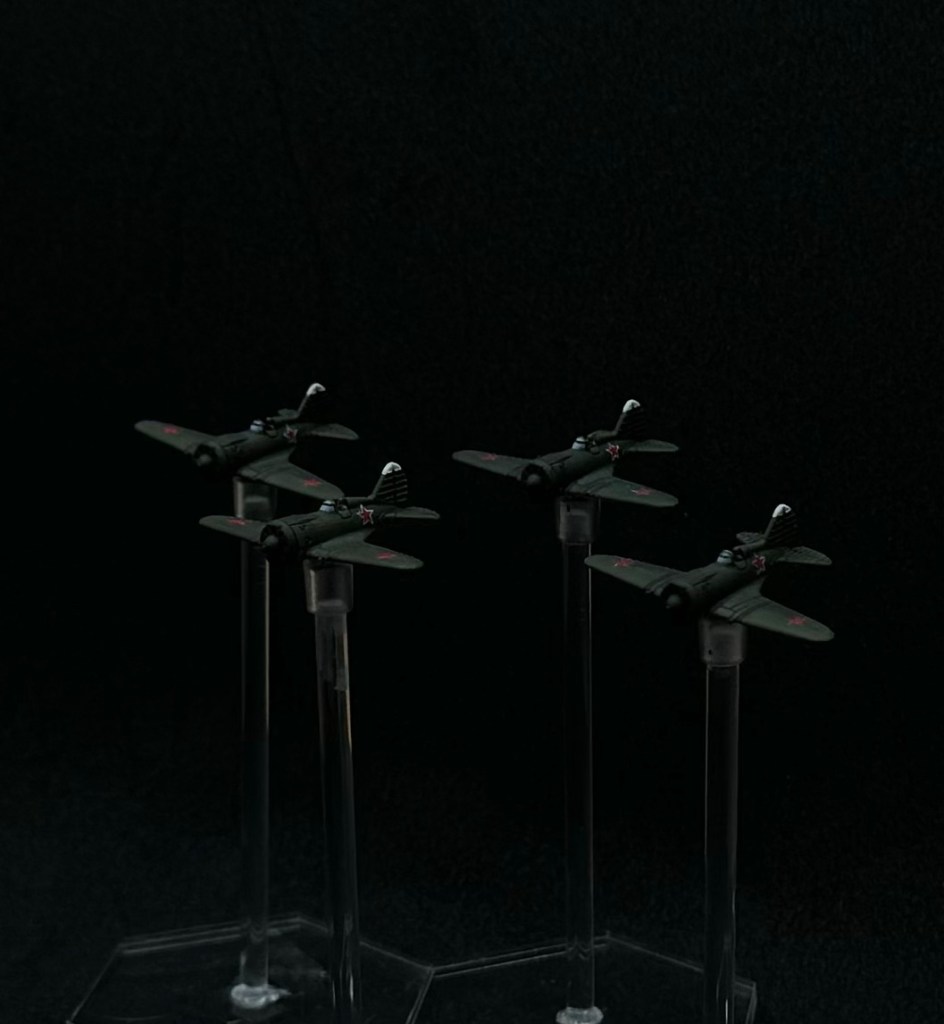
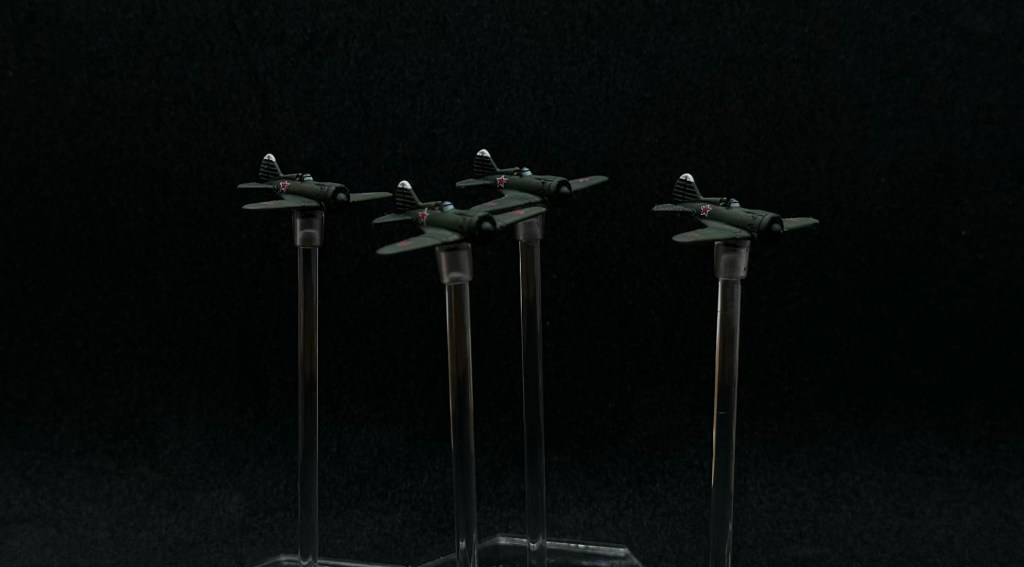
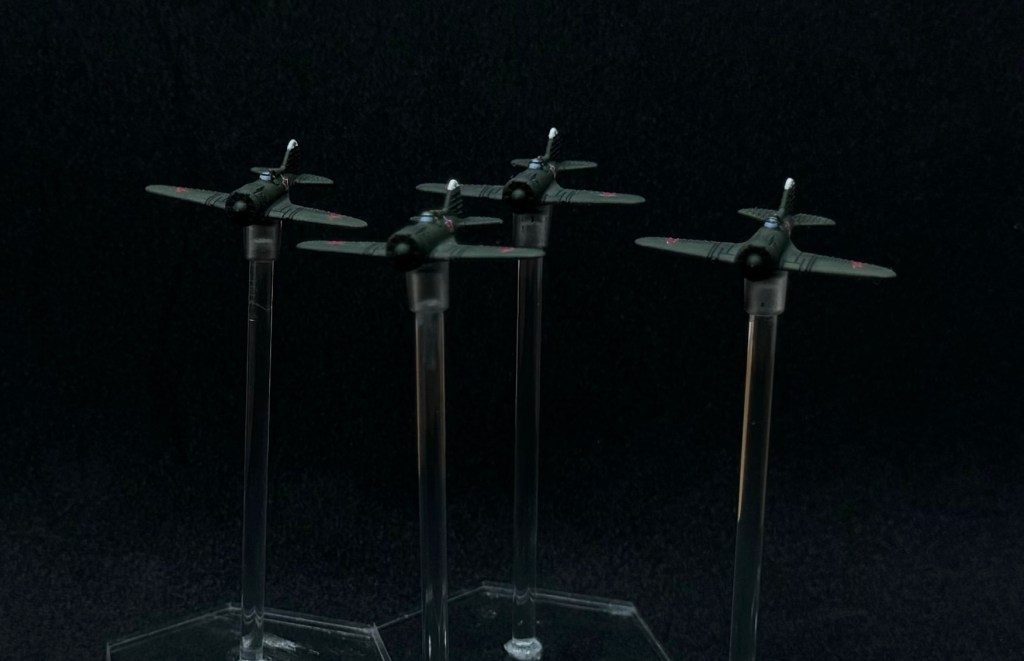
Well after these little fellas languished for two months waiting for their final matte varnish the first four of my Soviet Polikarpov I-16s are finally done.
I am far from a plane expert but I enjoy looking into aircraft and sharing what I learn. So, with that said I found out a lot about the hearty and humble I-16.
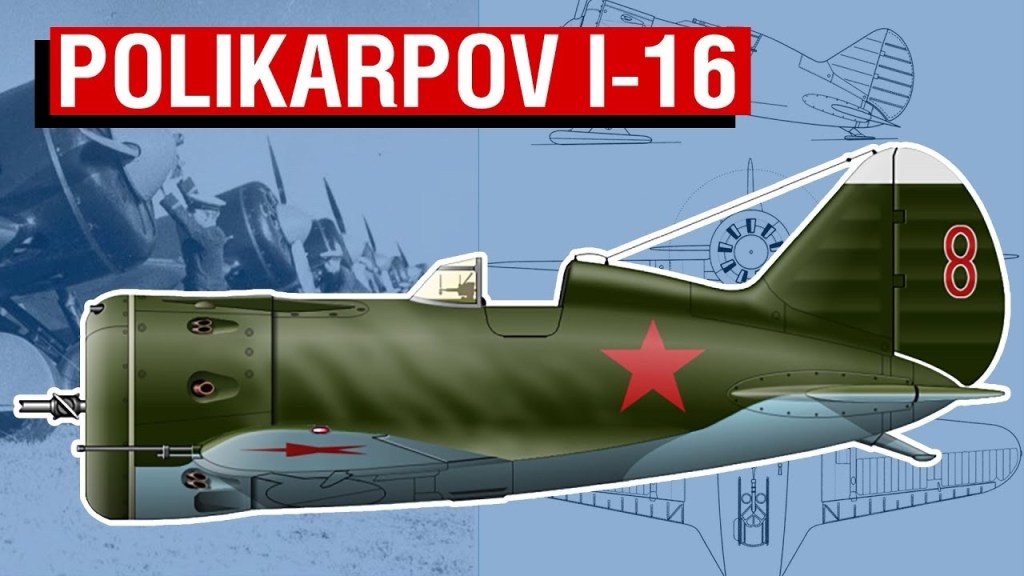
Affectionately known to their Soviet pilots as the “Ishak” (Donkey) the I-16 formed the backbone of the Soviet Air Force, the VVS, at the outbreak of Operation Barbarossa in 1941. For those who are interested in etimology like I am the nickname Ishak came about because it sounded familiar the Russian pronunciation of I-16 “ee-shestnadtset”. Plus the I-16 was apparently a tough little workhorse, so the name fits. Interestingly small animals were a naming theme with this aircraft as it was called the “Rata” (rat) by the Spanish Nationalists, “Mosca” (fly) by the Spanish Republicans, “Lastochka” (swallow) by the Chinese, and possibly my favorite “Siipiorava” (flying squirrel) by the Finns.
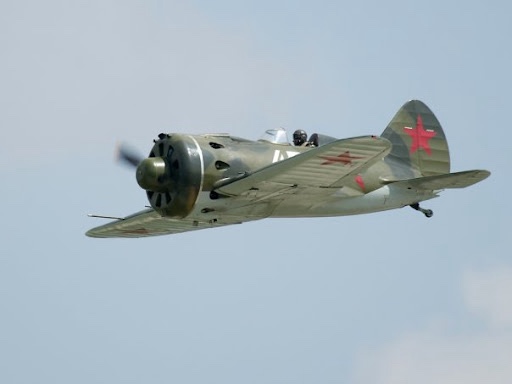
When it was first designed in 1933 the I-16 had cutting edge design principles such as retractable landing gear and a fully enclosed cockpit. It was short and maneuverable on the horizontal plane. With two wing mounted 7.62x54mm machine guns the I-16 was a standardly armed fighter for the time. Over time new upgrades were added and they were classified as Type X. There were 19 types (numbers were skipped as not all types were produced) plus numerous other versions.
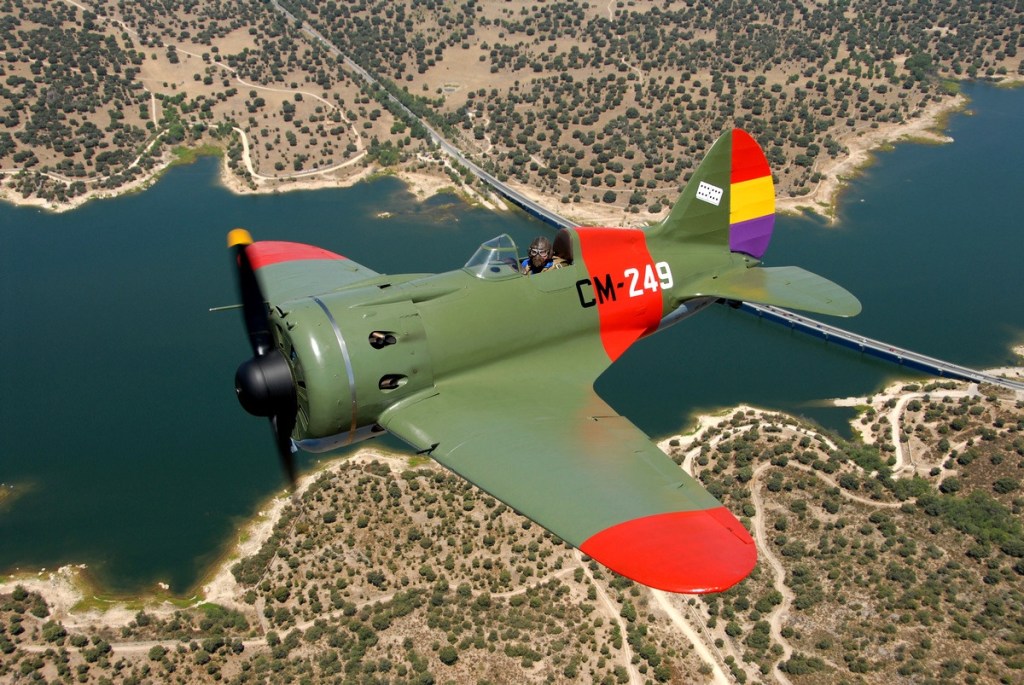
In 1936-37 the plane saw service in the Spanish Civil War under Republican colors. This provided a good test for the combat performance of the aircraft. It worked well against the bi-plane equipped Nationalist Air Force. When the Nationalists received new BF-109s from Germany things swung back the other way and the Polikarpov I-16s took heavy loses. This may be in part also due to the Republic air force being heavily outnumbered. The combat experience did lead to design improvements notably the evolution to the Type 6 and up-gunned Type 10.

Later Soviet I-16s saw action against the Finnish in the Winter War and against the Japanese at Khalkhin Gol. The Soviet and Chinese I-16s tangled with Japanese Nakajima Ki-27 fighters in the East. Experiences against the Ki-27s showed the need for more armor and heavier armament leading to the Types 12, 17, 27, and 28. While cannons were in short supply, some planes of these types were upgraded to carry 20mm pieces in place of their machine guns. While this made the I-16 one of the most heavily armed fighters of the time it also slowed the fighter down and decreased its performance. So… a new larger engine was fitted. For the most part this was the last significant change and the Soviet designers felt the airframe was at its limit. Apparently all the modifications had made it difficult to handle due to weight and balance. Unfortunately this lead to the plane to nose diving uncontrollably if the pilot was not experienced enough to counter the differing control experience.
In 1941 it would find itself coming up against the German BF-109E and Italian MC Saetta 200s. At the time the VVS had 1635 I-16s of all types in their inventory. They were fielded in 57 fighter regiments. The BF-109s were faster, more heavily armed, and had the advantage in climb rate and service ceiling. Despite the disadvantages the little Donkey had a few tricks up its sleeve. The I-16 could keep pace with the BF109 in turns and was actually more maneuverable than the German plane in horizontal movement. Both of these facts surprised the Luftwaffe pilots. When coupled with the almost suicidal bravery of the VVS pilots the I-16s were able to draw a significant amount of German blood. About half of the original I-16s were still in service when they were replaced by more modern aircraft in 1943.
In Bag the Hun

I am still a rookie pilot so this I tapped my tiny plane mentor Evan for a more through assessment and he excitedly obliged.
The I-16 comes off as a pretty typical early war fighter. The speed of 5-7 brackets is pretty common amongst its peers and the Ishak sits at a comfortable 6. That means you’ll have a movement speed budget of 7-10 depending on the D4 speed roll you make when moving it. Personally as a quasi benchmark the ability to pretty reliably have a budget of 8+ is an important one. Break Turn is an important maneuver if you’re trying to win a turning fight in Bag the Hun and it costs 4 speed, being able to (regularly) do that twice is a good advantage over planes that can only do it (probably) once.
Speak of turning the Rapid Roll (high rate of roll) ability allows the I-16 to change a single hex face left or right before moving. Rapid roll is huge and it’s a pain to deal with if you don’t have it.
Altitude wise the Ishak wants to be down low. It has a Maneuver rating of 6 at Altitude bands 1&2 while it drops to 5 at 3 or above. Most fighters are in the 5-6 Maneuver range, which some having superior maneuver as a tiebreaker. This rating comes into play a lot with tailing and shooting so if you’re piloting the I-16 you want to try to keep the fight down low, especially because this little plane can’t even make it to the Altitude 6 band to begin with (planes are capped at their ALT rating, in this case a 5).
The firepower is nothing to write home about but is pretty typical of the early war planes.
Overall I think in Bag the Hun the I-16 is a pretty average early war fighter which definitely wants to fight down low and keep turning. -Evan
In Blood Red Skies
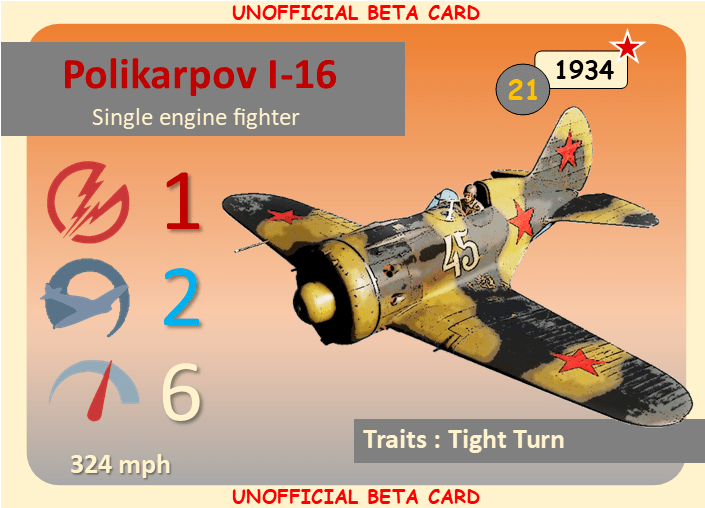

Evan once again obliged me with a look at the I-16s performance in Blood Red Skies.
As an early war design it doesn’t have a lot of firepower. There are a few variants here but both share some common features: Agility 2, Firepower 1, and Tight Turn. Tight Turn allows the plane to take its 45 degree turn at any point along its movement, not just at the end. Agility 2 is the middle ground in Blood Red Skies, as it ranges from 1-3.
The standard I-16 has a speed of 6, so you’ll be moving 3-6in with it (planes must move at least 1/2 of their speed, rounded up). Being able to play Tight Turn on occasion means you can keep it slow and turning if you need to.
The Type 24 variant suffers from one less speed, but still has to move at least 3 leaving you with less options at 3-5in. It also has Poor Quality which means it has a chance to start the game at a lower advantage level, but it does cut the points cost of the plane. I’m no expert but some of the Blood Red Skies folks seem to think Poor Quality is a worthwhile trade. Cheaper planes for a temporary disadvantage. I’ll leave that debate up to more knowledgeable minds. -Evan
The Planes
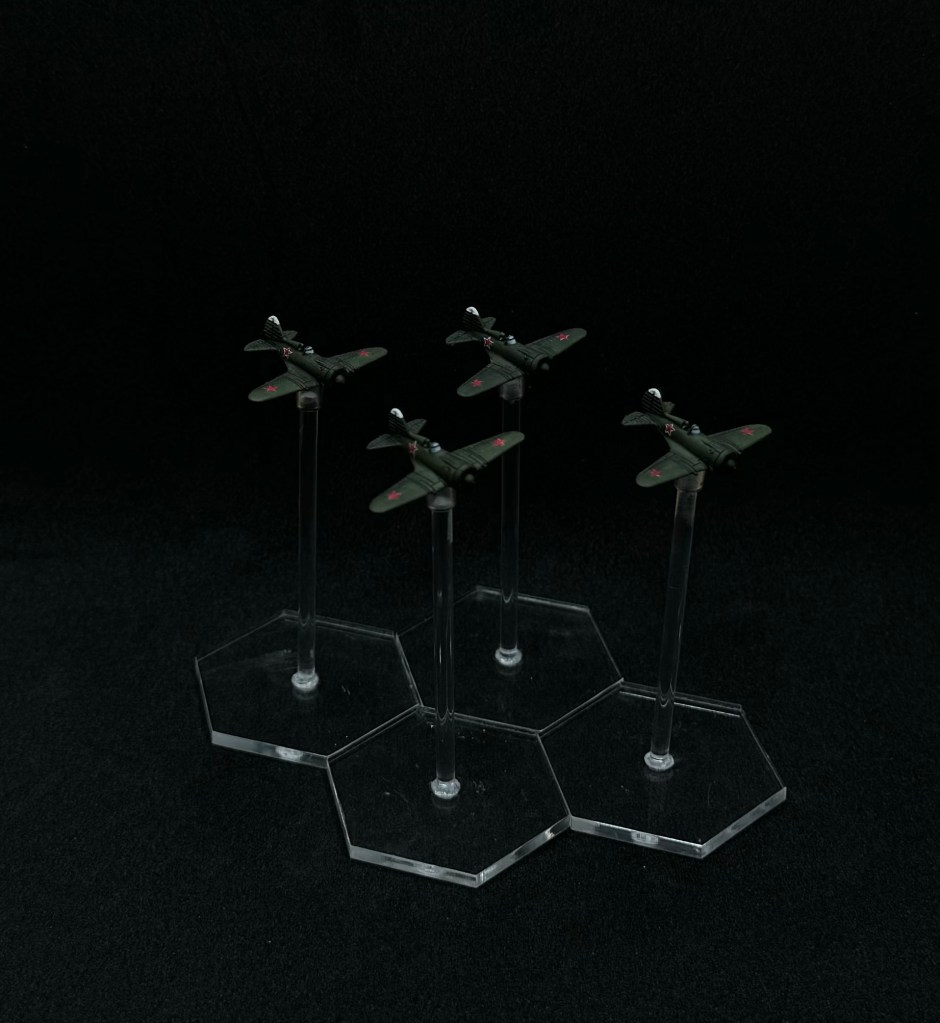
These I-16s are from the Plane Printer and resin printed in 1/300 scale. I plan on using them for Bag the Hun and Blood Red Skies. Evan was swell enough to print me planes as well as make me buy 70 some paints to doll up my aircraft with appropriate colors. Thanks Evan… truth be told I really enjoyed painting these up.
Due to the I-16’s ubiquitous service I found a dizzying array of paint schemes. Since mine were Soviet I focused on their schemes. Soviet squadrons had different color accents, number locations and fonts, and even camouflage patterns. This isn’t really that surprising giving being in service for a decade, across multiple fronts, with at least 57 squadrons. With more than 10,000 planes of all types produced I was more than spoiled for choice. Honestly I don’t know what squadron mine belong to but I liked the bright white on the rudder. It’s a splash of uncommon color on a wargaming table.
I have another four to paint, but I may ask for another eight to do up in Republican colors for some SCW aerial action. More of the little Ishak may be seen around these parts in the future!
Until next time, my “To Paint” 1/300 plane pile still numbers in the 100s… be smart kids. Don’t become addicted to little planes. Or do, it’s hella fun.
 Iron Dice Gaming
I’m late to the party again! Enjoyed the history, Ben! 🙂 I think the I-16 is one of my favourite planes! I like your models – the white fin flash does add a nice touch to them!
LikeLiked by 1 person