

Adepticon 2023 has come and gone. I have attended more Adepticons than I have missed since its origination. However, this was a unique one for me. This was the first year I’ve gone that I played in all historical events. While my primary WW2 game has been Bolt Action, with some dabbling in Flames of War years ago, Ben has been trying to convince me to try Chain of Command. As we are in the middle of our Stalingrad campaign for Bolt Action I told him I’d give it a shot afterward. An earlier opportunity came up at Adepticon this year with a narrative game for Chain of Command- “World Turned Upside Down- Malaya 1942”. I decided to give it a shot with Ben and Evan as a nice cool down game after a day of a doubles tournament for Bolt Action the previous day would have me feeling a lot less competitive.
Not sure how helpful or valuable this first impression review of Chain of Command will be, but just like Ben convinced me to try the game itself, he also pressured me into writing an article about my first impressions. He’s so persuasive!
Chain of Command is a WW2 platoon level game in the same vein as Bolt Action with fairly different peripheral mechanics surrounding a core of common wargame mechanics. It is written by UK based Too Fat Lardies. From what I understand the Lardies games are very much about flavor of whatever period they are covering, producing some interesting mechanics created to compliment the narrative drive. See Evan’s article for Bag the Hun to give you an idea.
In Chain of Command the theme is leaders. Leaders matter. They are the ones that drive your forces to do amazing things or nothing at all. This is represented in Chain of Command by the use of Command Dice and several other mechanics. As I have only played the game once and haven’t really delved into the rules or had any other experiences I will refrain from offering too many perceived insights into areas I simply haven’t read or experienced. I will however offer my initial impressions. I apologize for any incorrect names for mechanics or my faulty memory attempting to remember certain aspects of the rules exactly.
The game we played at Adepticon was run by a very gracious and passionate organizer named Liam. He made out quick reference sheets and was patient with the 3 of us at the table of 4 who had no knowledge of the rules. The battle was set in Malaya in 1942 with the Japanese advancing toward Singapore. The British were defending an area in a rubber plantation from a small bunker. Three quarters of the board was covered in rubber plants or jungle leaving very little line of sight, as one would expect from tropical Malaya. The British had several infantry squads, a Universal Bren Carrier and a bunker. The Japanese also had several infantry squads, a lot of mortars and a Chi-Ha Tank. Ben and I were paired up on the Japanese side and Evan and his teammate the Brits.
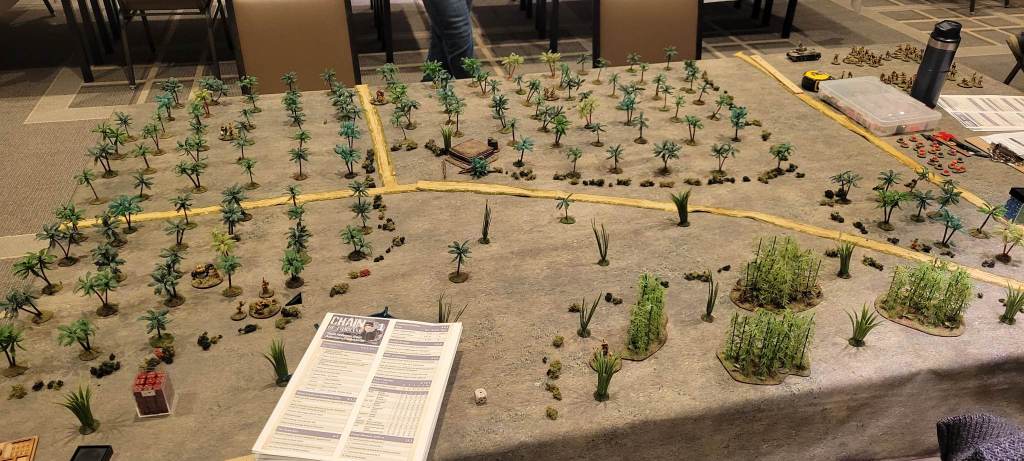
One of the unique things about Chain of Command is the “Jump Off Points” Instead of regular deployment zones this is used in Chain of Command to determine where your troops can enter in a “Patrol Phase”. We had three jump off points in this game and used a special ability called “Ruse” specific to the Japanese to move one up very close to the British bunker. I liked this mechanic as it gave a degree of tactical flexibility right off the bat. From my limited understanding of the rules, much like Bolt Action each army has its own special rules similar to Bolt Action’s National rules.
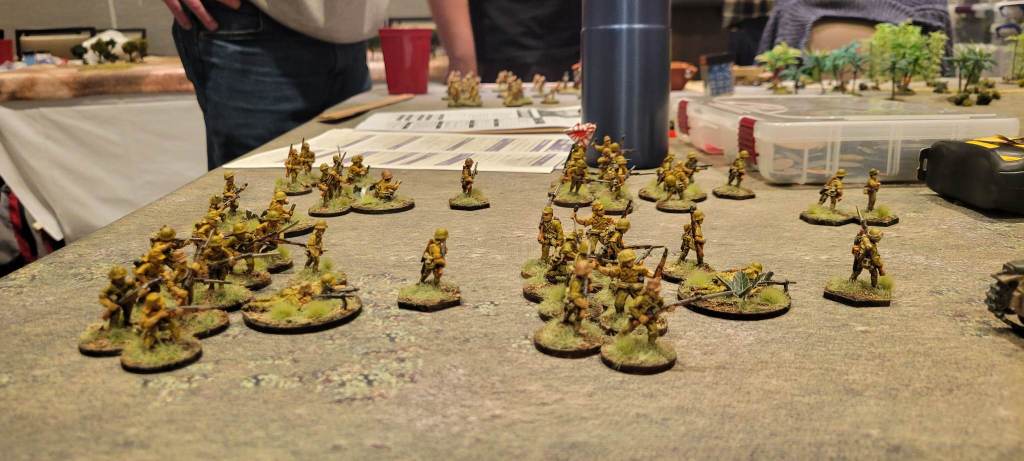
The Command Dice were another interesting feature as it determined what units could be activated in a “phase” I believe. These made it so the same units could be activated multiple times or others may not activate at all. It also allowed you to get creative with adding dice together to get a desired result. This created some randomness in who you could activate and some interesting tactical decisions. While at first I was a little turned off by the prospect of possibly never getting to move my tank or some other unit I had tactical plans for, it once again went back to reinforcing the importance of leaders and being able to manipulate their dice to make actions happen. While not always ideal for game purposes it may be a better reflection of real life. Without good and effective leaders to push their troops there might not be the desired drive to the objective.
Units take “Shock” in Chain of Command much like pins in Bolt Action. This affects their ability to be combat effective and carry out orders. This was reflected well in the rules and it is one of the things I very much appreciate about Bolt Action as well compared to some other games.
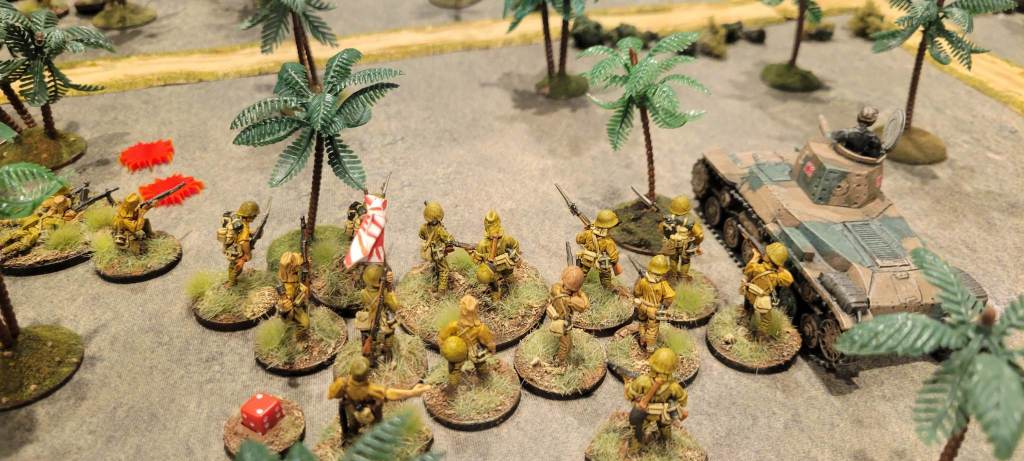
One rule I wasn’t a big fan of in the game at first was the random movement distances. I had four turns or phases in a row where I was only able to move a unit 6 inches in total due to their crappy die rolls for random movement. That was rather frustrating, but in hindsight it makes sense as even though you might order unit forward they may get caught up on terrain, injuries etc. Leading to having to having to deal with challenges from the best laid plans.
I have mixed feelings about the way indirect fire is handled. Whereas I don’t mind the big guns being off board and spotters simply calling things in, it seemed that spotters were just assumed for many of the indirect fire weapons. While apparently not as godlike in their hitting damage as they seem to be in Bolt Action they seemed a lot more accurate without many restrictions. This may or may not be a correct interpretation of the actual rules, but simply what I perceived from my first game.
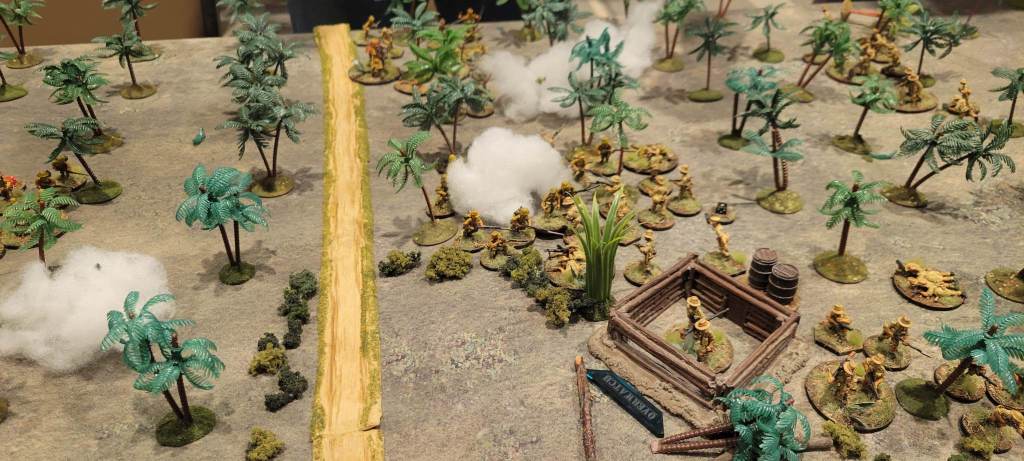
I really liked close combat and all the modifiers as they really made sense. Bolt Action’s close combat is much too simplified in my opinion whereas Chain of Command’s system makes a lot more sense to me. Many of Chain of Command’s rules actually seem to make sense, which I can appreciate. Some examples- Instead of shooting twenty four inches for a regular rifle as in some games you can actually shoot as far as you can see. Smoke mortars are a regularly used thing to block line of sight. Machine guns cause more shock. Tanks don’t simply move and shoot everything with impunity as they are limited by movement, visibility and other factors WW2 tanks were obviously hampered by. You can shoot and move infantry in an any order as opposed to the standard move then shoot mechanic so prevalent in many games. It lends itself to being much more realistic and organic with your actions in my opinion.
Typically the main objective of Chain of Command, from what I understand, isn’t to necessarily kill the enemy, but drive his morale down so he no longer has the will to fight. This seemed to be simulated very well in the game and eventually our Japanese were victorious in crushing the fight out of the British and taking the field despite sustaining severe losses ourselves.
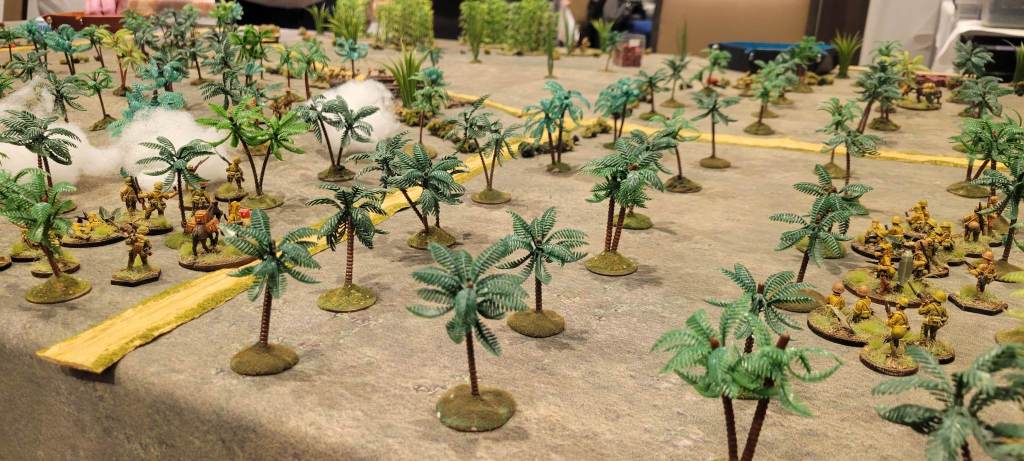
The game we played was pretty straight forward with the Japanese simply driving up a jungle hill to drive the British from a bunker with a little interaction from support units. While not a terribly complex or tactical scenario it was engaging and thematic. It allowed us a good chance to get an understanding of the rules due to its limited scope and was still a lot of fun.
Despite my critiques and limited exposure to the game so far I have to say overall the game felt very organic in how it played, despite the wonkiness of limited activations of certain units. I think delving into the rules more and playing a few more games will probably dismiss most of my criticisms as simply unfamiliarity and being used to playing for decades a certain way in games like 40k or Bolt Action.
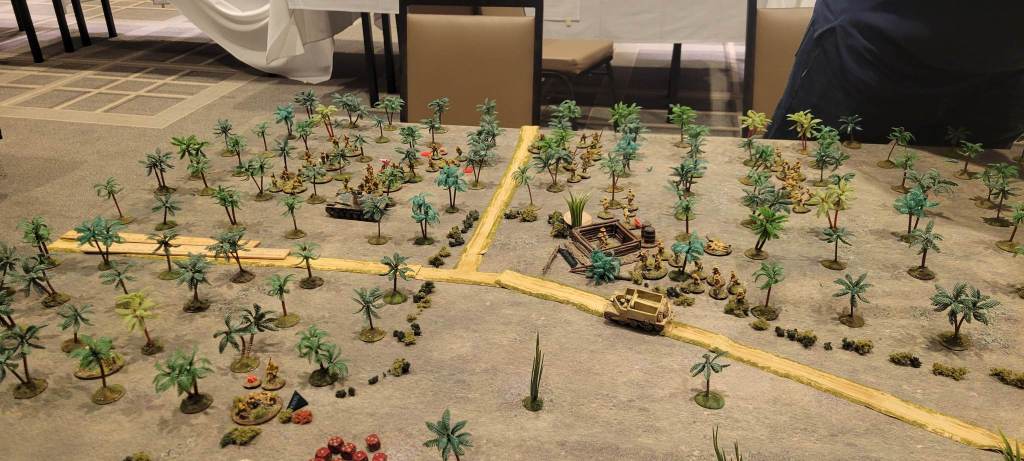
Overall I enjoyed Chain of Command and it hit many of the right spots for me as at my core I’m a narrative driven wargamer. I’m looking forward to playing some more in the future and in particular playing through one of the many mini campaigns designed for the game.
Until next time!
 Iron Dice Gaming