
This post started as a desire to record my progress building a Rubicon M26 Pershing kit to resemble Eagle VII, the Pershing tank made famous from the Cologne tank duel footage, and more recently Adam Makos’ excellent book Spearhead. I figured why not expand on the article with some more historical info and truly make it a full edition of History to Hobby.
History – Delayed Development & Late Arrival
The M26 Pershing began development in 1942 as a follow-up design to the Sherman and was designated the T20. As development continued the designations of different designs changed. The follow up T22 and T23 experimented with different transmissions. Lacking much input from the Army, who were happy to continue with the Sherman at the time, the design process was slow. The important item to come from this early process was actually the turret from the T23, which would go on to be used on 76mm Shermans. Despite some 250 of the T23 being produced, it was rejected for combat service in order to keep the US Army’s logistical scheme simpler.

As the need for a larger main gun than the 75/76mm began to be recognized during 1943-44 a new series of designs evolved in the form of the T25 and T26. Sporting more armor and a large 90mm main gun the T26E3 entered production in late 1944 with 30 units completed in December, 70 more in January, and more in February. By the end of the war some 2,000 T26E3 models were produced, though only roughly 200 saw deployment to combat units. In March 1945 the T26E3 was redesignated the M26 and named after General John J. Pershing, commander of the American Expeditionary Forces in the First World War.
Hobby – Getting Started: Inspiration and Source Material
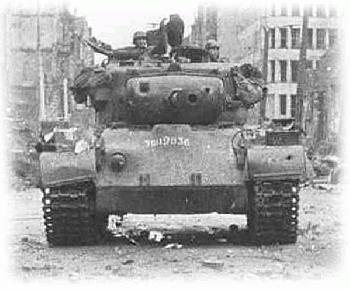
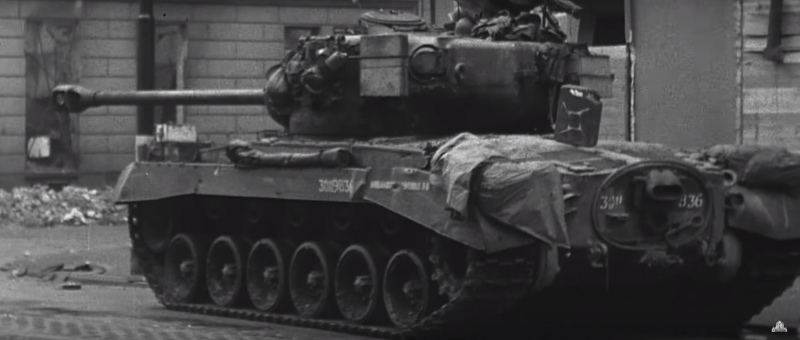
I’ve wanted a Pershing just because well…I love American armor and that’s the peak of it for the Second World War. Rubicon has a kit so I tossed it on a list of ideas I handed my wife for Christmas. Lo and behold, it arrived for the holidays. Coincidentally, I was just finishing reading Spearhead so I decided to do something a little different. I decided to try my best to recreate (something close to) a specific tank from a time and place via historical photographs. I searched up about every photo I could find of the Eagle VII, the M26 made famous in the footage from Cologne. I ended up with a good half dozen photos from various angles.




History – Combat Deployment
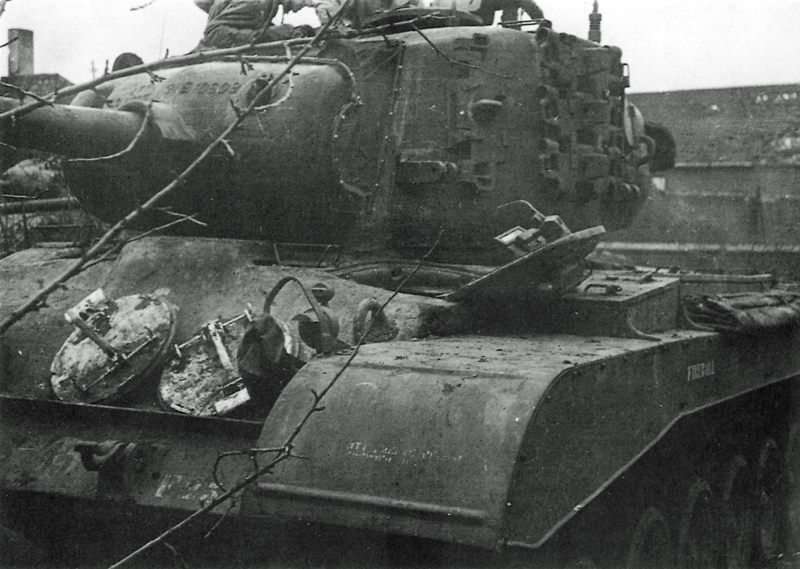
Though the first units were still technically T26E3s I’ll refer to them as the M26 Pershing from here on out. The first of the Pershings arrived in Antwerp in January 1945, having been ordered overseas at the height of the Battle of the Bulge the month before. The first combat engagement for the new tank came on February 25th 1945 by the Third Armored Division near the Roer River. The next day saw the first combat loss for the M26 as a Pershing named Fireball was knocked out by a German Tiger in an ambush. However, it was repaired and returned to service in early March. During the battles in late February the Pershing claimed several victories including one Tiger and two Panzer IVs. As February turned into March the Third Armored moved towards Cologne.
Hobby – Recreating History…….with Green Stuff
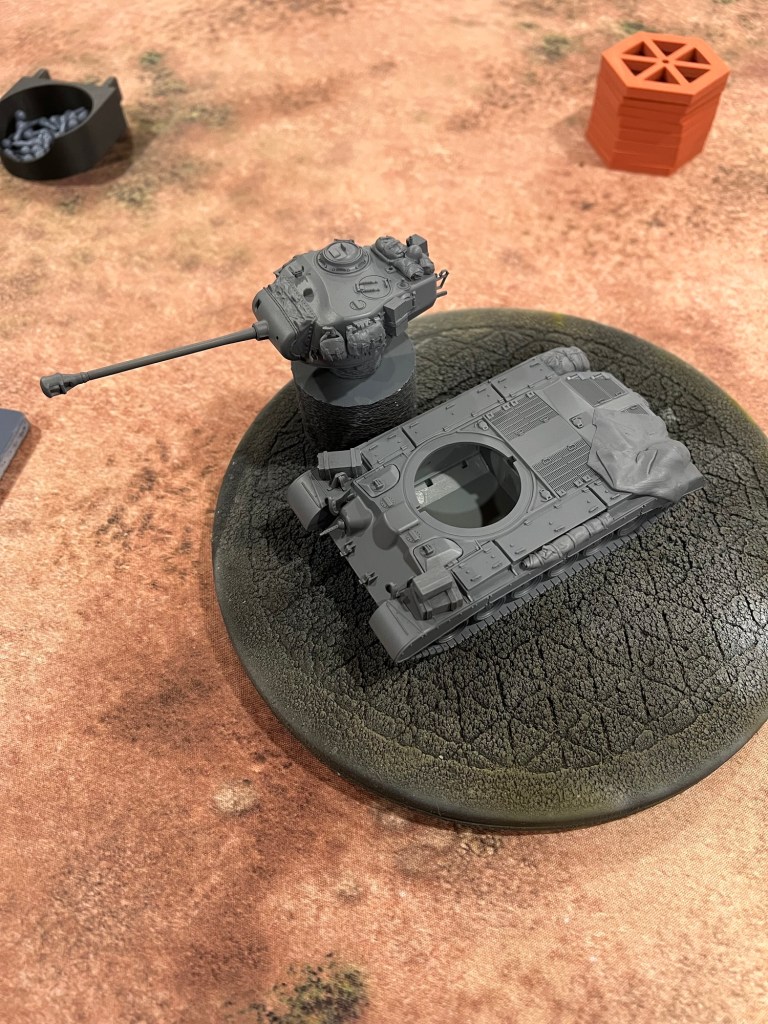
I assembled the Pershing kit, which like all Rubicon kits was a pleasure. With the base tank assembled I went through my large bin of 3d printed and ValueGear 28mm stowage looking for bits and bobs to make the correct items, or close to them, from the photos.
On the front left appears to be some stacked boxes or crates. On the front right a crate or box, or sometimes two. I opted to just do a single crate on one side and a pair on the other.
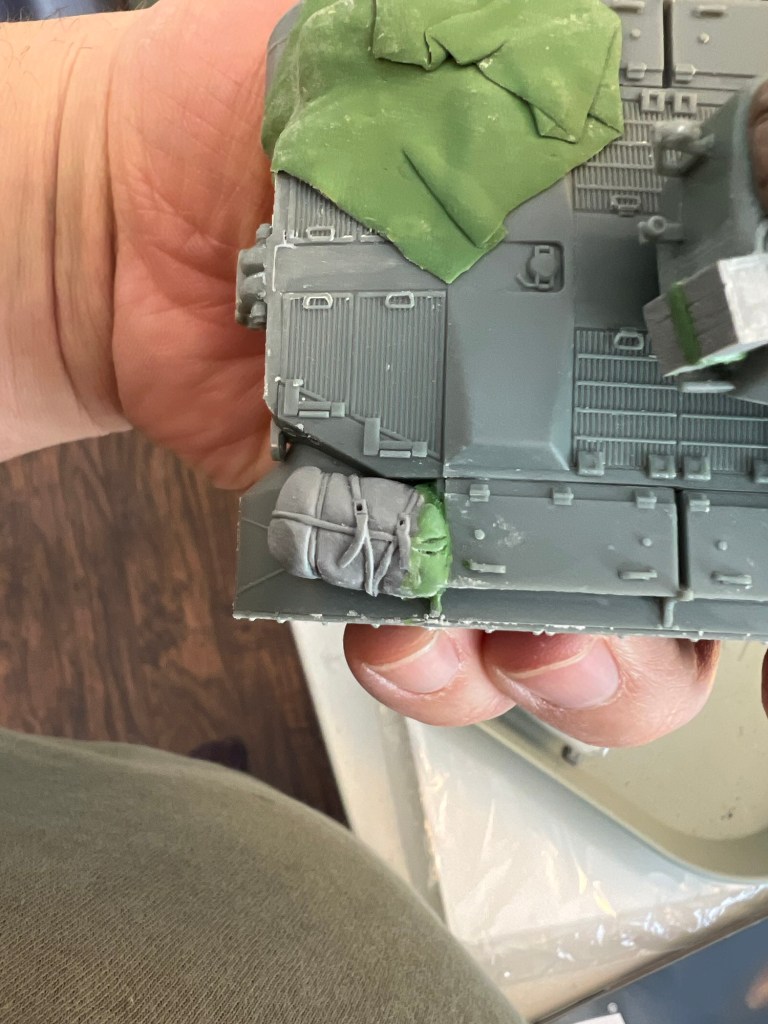
On the left side is a long wrapped bundle which I added. The back left sees a tarp draped over…something. I utilized greenstuff to roll a thin tarp and press it down over a piece of stowage I added at the rear left to make it seem like something was over it. On the back right I cut down a bundle of stowage to fit, then filled in the cut off part with green stuff sculpted to be close to the rest.
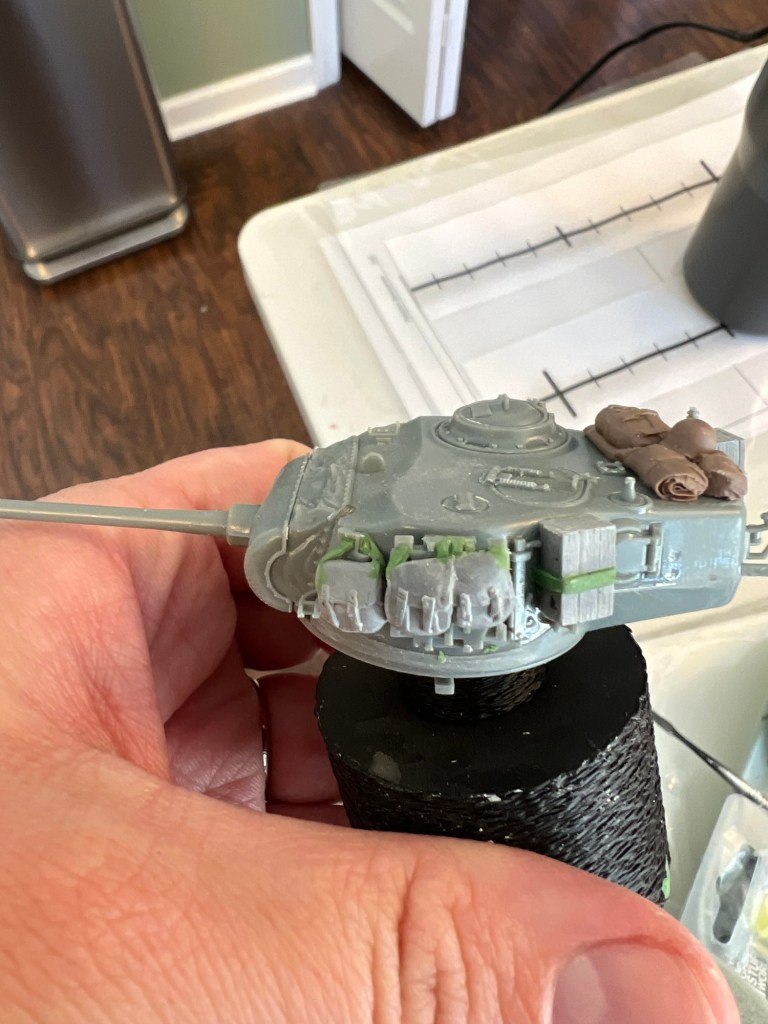
On the turret I added the rucksacks hanging from the spare track links. I had to make the straps for them from green stuff. Speak of green stuff I had to make what appears to be strappings around boxes that can be seen on the turret. I added some stowage bits on top that looked close-ish.
The items I chose to not to in this recreation were the jerry can on the engine deck. I have one, but it seemed like something that would get broken off over and over again, so I omitted it for wargaming reasons. I also did a normal pintle M2 .50cal HMG despite it appearing to be covered in a wrap or weather cover in the photos. I just didn’t have any more green stuff work in me.




History – Eagle VII, Cologne, and the M26’s Legacy
In March 1945 US forces entered the German city of Cologne. Though met with some resistance, German armor was rare inside the city. However, before I prattle on a bit, if you haven’t seen the famous “Cologne Tank Duel” footage go watch it here. This quick tank duel between a Panther and a Pershing named Eagle VII is well known due to it having been caught on film. It also features prominently in Adam Makos’ book Spearhead, which follows the wartime experience of the M26’s gunner Cpl. Clarence Smoyer (and others). In Smoyer’s own words:
“We were told to just move into the intersection far enough to fire into the side of the enemy tank, which had its gun facing up the other street [where the Sherman had been destroyed]. However, as we entered the intersection, our driver had his periscope turned toward the Panther and saw their gun turning to meet us. When I turned our turret, I was looking into the Panther’s gun tube; so instead of stopping to fire, our driver drove into the middle of the intersection so we wouldn’t be a sitting target. As we were moving, I fired once. Then we stopped and I fired two more shells to make sure they wouldn’t fire at our side. All three of our shells penetrated, one under the gun shield and two on the side. The two side hits went completely through and out the other side.”

The M26 continued to see action throughout Europe in the last months of the war. Several were shipped to the Pacific for use on Okinawa but did not arrive until two days before the first nuclear bomb was dropped on Hiroshima on August 6th. By that time the fighting on Okinawa was mostly over and the war’s end would soon follow. The M26 Pershing would fight again in the Korean War in 1950, this time against Soviet built tanks. Additionally, the M26 would be developed into the M46 Patton, the M46 lineage would extend all the way to the M60 tank. The M60 would see frontline combat service with the United States until Desert Storm in 1990-91, and is still in service with some other countries.

Hobby – Painting the Eagle VII
To paint the Eagle VII was actually pretty easy. US armor is easy with a nice solid OD green as the color of most of it. I used AKG3 Olive Drab Base and drybrushed it up with AKG3 WW1 German Grey-Green. I then did the tracks using a base of Pro Acryl Brown Grey and adding a “magic mix” rust wash I picked up somewhere along the way (I think it came from a Warhammer Reddit). The rust mix is: 5 parts Vallejo 76.507 Dark Rush Wash, 3 parts Dirty Down Rust, 2 parts water. It needs a really good mixing and a good hour to set between coats. I did 2 coats of this and finished it with a drybrush of a Vallejo Metal Color Steel.


I painted the stowage with a variety of appropriate colors before giving the model a gloss clear coat. I added a few appropriate decals from the Rubicon sheet that comes with the kit (it has a small set for the Eagle VII). After the decals were set I did some chipping with brown greys and dark browns. Then it was time for another gloss coat preparing the tank for a coating of AK Winter Streaking Grime. I reduced the grime off with some white spirits until I had a result I was happy with. I then followed up with the final clear coat.


Overall, I am happy with the result from this little project. It was a little different experience for me to so carefully try to recreate a specific tank from photos. Nevertheless it was an interesting exercise, and even forced me to confront my longtime hobby nemesis: green stuff. (Fine, it wasn’t that bad really. Thanks to Ben and ScaleHistorySLC for the tips!)
Thanks for reading, I quite like this article format so look for more History to Hobby in the future.
Evan
 Iron Dice Gaming
Well done, lovely work in the Pershing. I love that you’ve gone for a real life vehicle at a particular time and place. Very cool.
LikeLiked by 3 people
Thanks! It was definitely something different for me. Usually I try to keep things on the generic side.
LikeLiked by 1 person
Now that is really nice, Evan! 🙂 I’ve always liked Pershings – they have a nice solid appearance that says “don’t mess with me”! I like the sound of “History to Hobby” as well!
LikeLiked by 2 people
Thanks John! I quite like the Pershing as well, the squat boxy body just make it seem larger than it is.
LikeLiked by 1 person
The stowage you’ve added really looks natural. What a great subject to model as well. I really enjoyed Adam Makos’ book and your tank does honor to the crew who fought that valiant battle.
LikeLiked by 2 people
Thanks Chris! It was a fun little project.
LikeLiked by 1 person