
Welcome back, or just plain welcome if you didn’t catch the first article. If not I recommend going back and giving it a read here: The Pilots
In that article I laid out the cast of characters for this campaign. In this article I’m going to lay out the background, how the campaign works, and what kind of historical tweaks I’ll be making along the way.
Campaign Background
As you may have guessed after reading that the pilots in the campaign are from the US Navy, the setting is the Pacific Theater, more likely with a focus on operations in the Central Pacific. I am not setting out to simply reenact the aerial battles of the Pacific in exacting detail, but instead I aim to provide an entertaining narrative story about a band of fictional aviators fighting in actions typical of the theater as well as some of the big ticket battles. To make this a realistic goal this campaign is one of historical fiction. Think of it as the TV series version of the air war in the Pacific.
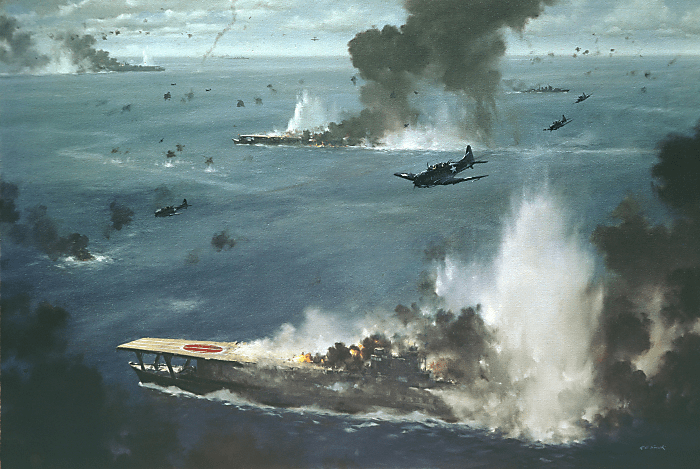
We’ll be sure to visit Midway during the campaign.
To suit the campaign to my goals I will be taking some historical liberties, specifically:
1. The aviators will belong to a fictional squadron. I would find the pull of history too strong to be in the right place at the right time if I used an actual squadron.
2. The squadron will belong to a fiction aircraft carrier. Along the same lines as the first point. For the purposes of the campaign we will assume the addition of a US carrier has no larger impact on the war, even if it very well may have in actuality.
3. The pilots will not rotate out of the front lines. In reality the US Navy had schedules of rotation that ensured pilots did not spend an inordinate amount of time on the front line. They would be rotated back stateside to participate in training new recruits. Notably at least one historical ace, Alex Vraciu, talked his way into remaining longer at the front. I have decided that the cast of the campaign will have an equal attitude, and will get their rest at R&R opportunities along the way.
4. Historically, as the war dragged on the quality of pilots available to the Japanese forces declined markedly. I will be sure to have this be a realistic factor as we go on, however I will still attempt to keep the games fun and challenging along the way. The result is I will likely blunt the reduction in Japanese pilot skill somewhat.
5. I’m sure most readers here know how the war in the Pacific concluded. Should the brave pilots we follow survive to 1945, I am (as of writing this) inclined to allow the war to drag on a little for one reason or another. This is simply because there are some fun late war aircraft that either became functional too late or, in the case of many Japanese designs, never saw operational use at all. However I think for the sake of a good time with miniatures we can all agree “it’d be cooler if they did”.

How the Campaign Works
Squadron Forward lays out a way to run a narrative campaign in any aerial wargame. This essentially boils down to some administrative steps before and after games in order to layer on the narrative detail. The first chunk of the book we already covered in the first article, which was generating your characters. Squadron Forward then lays out some steps for a player to follow:
1. Receive Your Mission- The book is full of tables and conditions that allow you to generate a whole mission on the fly. This is great, and though I won’t use it every time (there are some specific things I’d like to do) I’ll be sure to do some of them, and cover that process in depth in a separate article.
2. Events- The book has some events to add some spice to the game, after all combat is not a clean and well organized affair, or at least not air combat in the Second World War. These take the form of three categories:
Pre-Combat: weather, aircraft malfunctions, pilots with cold feet
In-Combat: a whole table of things from reinforcements for either side to good or bad character events
Post-Combat: Reputation modifications, repairs, replacement characters, or citations.
3. Fixed Events- These are essentially post-mission narrative events, both good and bad, which will happen to your squadron after a combat mission. These are mostly things like “a character gets a promotion”, however there are also mechanics to involve NPC characters and to deal with your higher ups. These influence your squadron down the road and help tie everything together.
In future mission articles for the campaign we will cover the assigned mission, what happens before, during and after. All of these factors can be easily done from a single book which is very handy in my opinion. I’ll save more details on these mechanics for future articles as well as for a full review of Squadron Forward once I play it through.
That’s all I have for you this time. In the next article we’re going to cover how I went overboard on materials preparation for this campaign (I have to paint some models first though!).
 Iron Dice Gaming
3 thoughts on “Bag the Hun Pacific Campaign: The Setting”