


The Idea is Planted
Back in December of 2022 my local gaming club, the Wisconsin Wargaming Brigade, hosted a private event for the 78th anniversary of Operation Watch am Rhein. If that name sounds little familiar but hard to place it was better known as The Battle of the Bulge. We had enough members wanting to play that 3 simultaneous games of Bolt Action were able to happen.
Chad, Mike G. and I decided to play a 1400 point game. The attending club members decided it would be a casual and “fluffy” event rather than a competitive one (which, to be honest, is exactly how I like it). Mike and I were assigned to lead elements of the 26th Volksgrenadier Division to take the outskirts of Bastogne while arrayed against us was Chad’s mishmash of American paratroopers and infantry strung along the perimeter of the pocket. Both sides had access to armored support. Mike and I decided to each bring a 700 point force pulled from the Watch on the Rhine selector out of the Warlord Games Battle of the Bulge campaign book.
Planning for the event started in late August, which gave me about 4 months to paint up 700 points of a new army. It’s well documented that I like to have a lot of irons in the fire. I usually have a few projects on my desk in various stages of completion. My hobby productivity is also limited by the amount of free time I have. And as a father of young children, that time is nonexistent sometimes. This played a large role in how I planned my project. But I was pretty confident I could knock out a medium sized new army in 4 months. How bold of me…
Historical Background

The 26th Volksgrenadier Division was a reconstitution of the 26th Infantry Division with the addition of the newly formed 582nd Volksgrenadier Division. This occurred in the Fall of 1944. The 26th ID fought in the Battle of France and later on the Eastern Front, including the Battle of Kursk, and the fierce fighting leading up to it. The 26th ID was a seasoned, albeit heavily depleted, unit by December of 1944. I figured there would be some experienced NCOs and enlisted men to mentor the men who were shifted from other non-infantry positions to fill the platoon. Many Volksgrenadiers were equipped with extra short range firepower and fought with great tenancy. With this in mind I felt that the platoon could be considered a regular rated force instead of an inexperienced one for the purposes of Bolt Action.
As Operation Watch am Rhein was to be a war winning, or rather peace bargaining chip, operation the offensive saw the commitment of a large chunk of Germany’s remaining armored forces. Many of the forces committed to the assault were handpicked by Hitler. Faced with fuel shortages the armored vehicles would have to be used strategically. That being said some of Germany’s most powerful armor was given as support to the Volksgrenadiers.
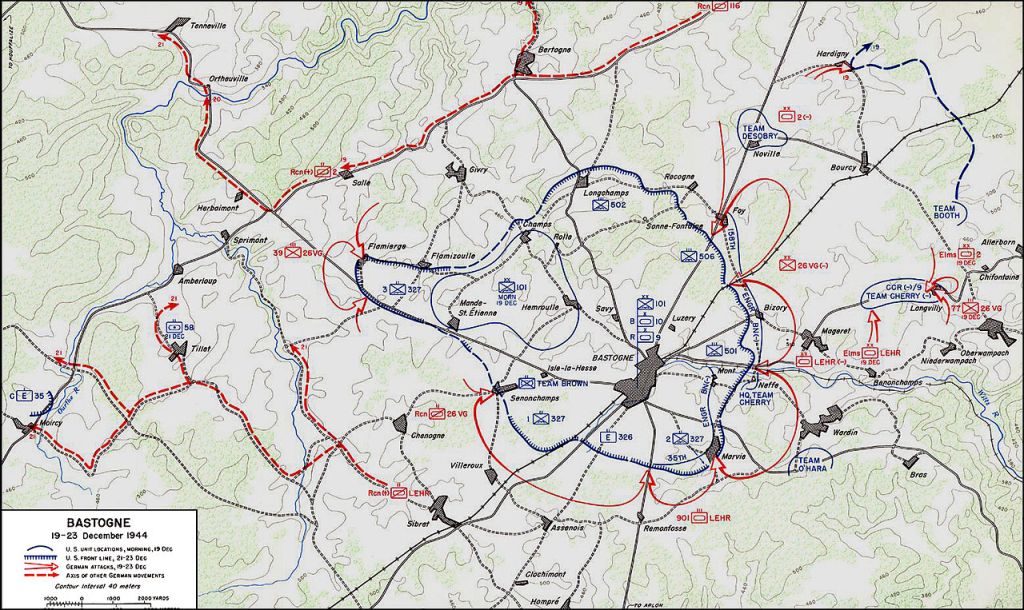
The overall goal of the offensive was the Belgian Port of Antwerp. As the Ardennes area was heavily wooded roads were critical to keeping the German tank forces moving. The village of Bastogne was located at the intersection of seven roads and it doesn’t take much to understand why it was a key objective for the German assault. Three division were committed to taking the 11km front which included the village. 26th Volksgrenadier, 2nd Armored, and the vaunted Panzer-Lehr Division were to take the village before continuing west.
Force Composition
I knew I wanted to be able to use the platoon for both Bolt Action and Chain of Command. Ideally I wanted to be able to use some of the riflemen for a mid war winter force as well. After perusing my Chain of Command Bloody Bucket Pint Sized Campaign (PSC) I decided to model my platoon after a Volksgrendier rifle platoon. The Bloody Bucket campaign focuses on a different area of the Watch am Rhine offensive but I imagine the German forces would be similar enough. But after some consideration about Bolt Action points I ended up using the German rifle platoon organization from the main Chain of Command rulebook. The Bloody Bucket Volksgrenadier rifle platoon was issued an extra SMG per squad and had a reduced maneuver element. I will come back to that platoon structure at a later time as I think it is very flavorful and represents the firepower of the Volksgrenadier units well.

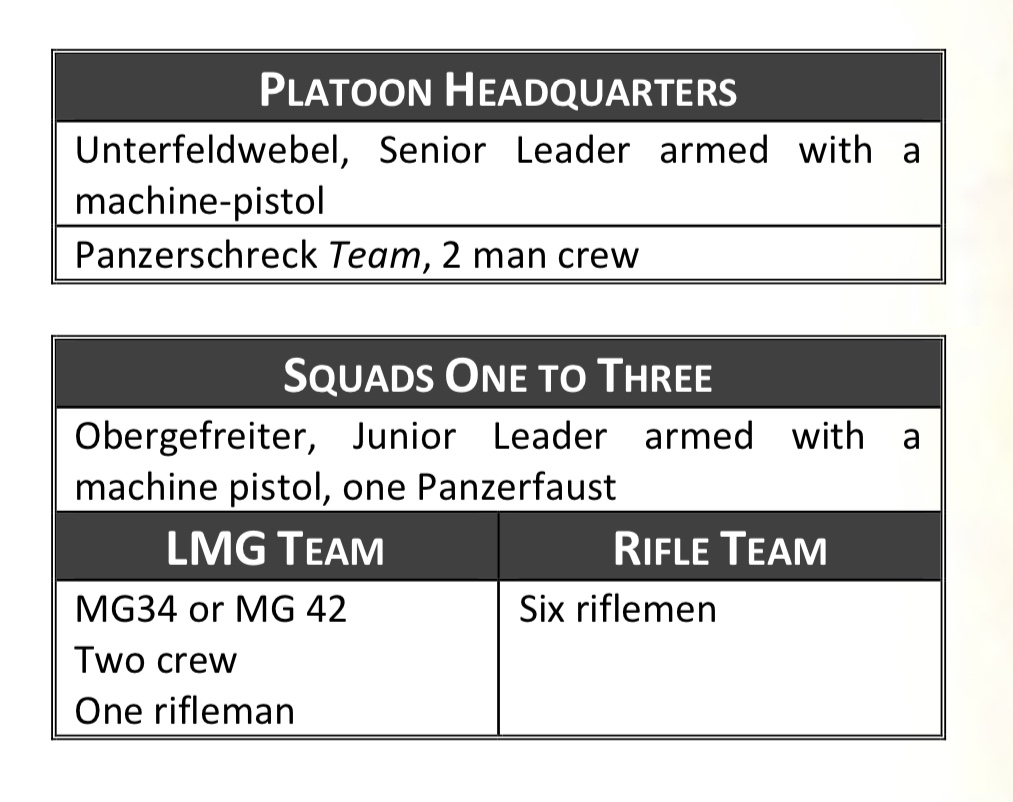
A Bolt Action platoon requires a minimum of a platoon leader and two squads. I started with a regular second lieutenant with no bodyguards to match up to the CoC platoon. For some reason I thought the Unterfeldweble (lieutenant) was armed with a pistol so that’s what I ended up giving him. I realized my mistake about 2 weeks before the event but it ended up being ok in the end. He must have lost his MP-40 in his haste to fight the Tommies.
At the core of the force are the rifle squads consisting of one NCO with a MP-40 sub machine gun, a six man rifle armed maneuver element, and a three man light machine gun team. One panzerfaust had also been allotted to each squad. I took two of these squads at a regular experience level. I figured I would be able to paint up the remaining rifle squad, rifle grenadier squad, panzerschreck team, and extra SMGs for the CoC platoons at a later date.
With the lieutenant and two squad I was committed to painting 21 miniatures. The infantry component of my platoon was sitting at 306 points. Our scenario had the frostbite special rules which meant at the beginning of the game each unit had to roll a morale check. If the check was failed some men would become casualties before the game started. I could have purchased cold weather gear for my boys to prevent the check but I decided to gamble it. Sorry Hans, no scarf for you.
Jagdpanther tank destroyers were used to support the German Ardennes offensive and I have always admired them. There is something striking about the solid mass and the angle of the thick armor plating. Naturally I jumped at the opportunity to paint my first big cat. Costing a mere 390 points, toting a super heavy anti-tank gun and hull mounted MMG, and coming in at a whooping armor 10 I knew it was a perfect way to finish off a “quick” new army. The Jagdpanther could also be used in Chain of Command where it was equally as fearsome. Sitting on support list 12 with an AP of 16, HE of 7, and an armor value of 11 it was a force to be be reckoned with, albeit an expensive one. Unfortunately the Jagdpanther is not available in the Bloody Bucket PSC but I could still run it outside of the campaign.

696 points; four order dice. I figured I had some infantry to push objectives and a really big stick to beat up any Allied armor that showed up to play. Our scenario also had the fuel shortage rule so we would need to be smart about how we used our armor. Luckily Mike would be bringing some more bodies to help push our advance forward. We needed the help.

With my force selected, it was on to the next part of my process, the preparation stage. I will cover that in Part 2!
 Iron Dice Gaming
One thought on “Late War Winter Heer Part 1: Planning”